
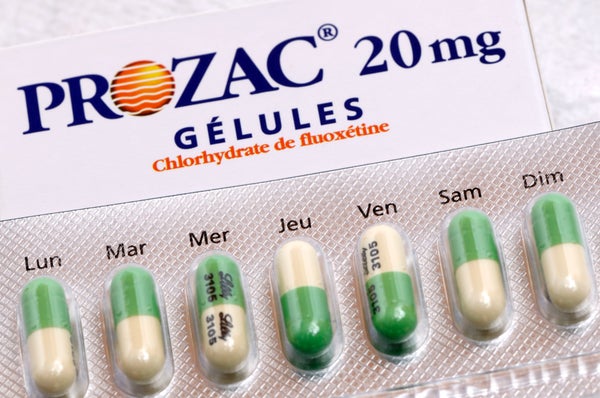
Prozac (fluoxetine) and similar antidepressants are among the most prescribed drugs in the United States, but scientists still don’t know exactly how they work. Now one piece of that puzzle—the structure of a protein targeted by several widely used antidepressants—has been solved.
The finding, reported on April 6 in Nature, could enable the development of better, more-targeted depression drugs. But it may come too late for drug companies, many of which have abandoned the search for depression treatments.
Prozac and its kin—drugs called selective serotonin reuptake inhibitors (SSRIs)—were first discovered in 1972. They address one hallmark of depression: low levels of the molecule serotonin, which neurons use to signal one another. By preventing a protein called serotonin transporter (SERT) form absorbing the serotonin back into neurons that release it, the drugs boost serotonin levels in the junctions between cells.
On supporting science journalism
If you're enjoying this article, consider supporting our award-winning journalism by subscribing. By purchasing a subscription you are helping to ensure the future of impactful stories about the discoveries and ideas shaping our world today.
But the details of this mechanism have long eluded researchers, who have sought to crystallize and visualize the SERT protein since the early 1990s. “It’s tough to make, and once you make it, it tends to fall apart in your hands,” says Eric Gouaux, a crystallographer at Oregon Health & Science University in Portland.
Gouaux and his colleagues finally succeeded by creating small mutations in the SERT gene to make the protein more stable. For the first time, they were able to see the pocket in which two SSRIs—Paxil (paroxetine) and Lexapro (escitalopram)—bind. They also identified a second pocket, called an allosteric site. When escitalopram binds to both sites, the transporter protein and the drug bond more tightly, which increases the medicine's effect.
“It’s a beautiful piece of work,” says Christopher Tate, a biochemist at the MRC Laboratory of Molecular Biology in Cambridge, UK. Understanding the structure, he says, could lead to the development of more-effective depression drugs with fewer side effects.
Rethinking depression
Over the past decade, most major pharmaceutical companies have ceased research into and development of new psychiatric drugs—a task that has proven to be complicated, expensive and fruitless. The vast majority of drugs approved to treat depression over the past few decades have been “me-too” drugs with similar structures and functions. The many SSRIs that followed Prozac are only one example of this.
Kenneth Jacobson, a medicinal chemist at the National Institute of Diabetes and Digestive and Kidney Diseases in Bethesda, Maryland, hopes that the discovery of the SERT structure will revive interest. “Drugs to treat behavioural disorders are still needed,” he says. “This could possibly create a rebirth of the field.”
In the meantime, thinking about what actually causes mental illness has shifted. Researchers no longer believe that depression is solely caused by low levels of serotonin or other signalling molecules in the brain, says Richard Friedman, a psychiatrist at Weill Cornell Medical College in New York City.
“They’re really circuit-level disorders that involve problems with communication between different circuits in the brain,” Friedman says. Rather, some types of depression involve abnormal serotonin levels in certain parts of the brain, he says, which may help to explain why SSRIs do not work for everyone.
The way forward
Yet Friedman and others still find the latest paper exciting. Gouaux says that his team and others are looking at naturally occurring mutations in SERT that may predispose some people to be more or less prone to depression. If the mutations result in different SERT protein structures, a person's DNA might predict whether SSRIs would work.
Researchers are also working to crystallize the transporter proteins for two other neurotransmitters—dopamine and norepinephrine. Their DNA sequences are similar to that of SERT—“they’re almost like a group of triplet humans,” Gouaux says— but there are subtle differences in how the proteins bind molecules.
Understanding these differences may elucidate the broader roles that various neurotransmitters have in mental illness and drug addiction. An paper published in April from Jacobson’s lab shows that the dopamine transporter (DAT) also has an allosteric site similar to that of SERT. Molecules such as cocaine bind to and block DAT, which increases dopamine levels outside the cell. Jacobson and his colleagues found a group of small molecules that can enhance this interaction by binding to the allosteric site. These findings could lead to better drugs for dopamine-deficiency problems, such as attention-deficit hyperactivity disorder.
But in the meantime, researchers and patients are left waiting for other discoveries that might pin down the exact cause of depression. “Look, I hope there’s a miracle,” says Steven Hyman, director of the Stanley Center for Psychiatric Research in Cambridge, Massachusetts. “Barring that, what is really going to advance therapeutics are entirely new disease mechanisms.”
This article is reproduced with permission and was first published on April 6, 2016.