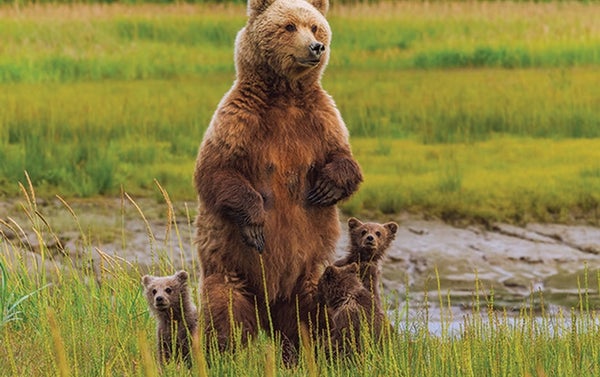
Mysterious Bear Dance Explained

Brown bears paw the ground to leave one another smelly messages

Art Wolfe Getty Images

Join Our Community of Science Lovers!

For decades bear biologists have known that bears engage in a delightful ramble variously dubbed “sumo strutting,” “cowboy walking” or, simply, the “bear dance.” Many researchers have guessed at the reason, but a recent study finally offers solid clues.

As they walk, the bears vigorously twist their feet into the ground. Sometimes they step into footprints left behind by other bears after giving the prints a good sniff. Some have referred to these collective tracks as bear highways because they become well traveled over time.

“Everyone suspected that there was something in [the footprints],” says Agnieszka Sergiel, a biologist at the Polish Academy of Sciences' Institute of Nature Conservation and a co-author of the study, which was published recently in Scientific Reports. “But no one really investigated.” She and her colleagues wondered whether the bears deposit their scent through glands on their paws as a means of communication.


On supporting science journalism

If you're enjoying this article, consider supporting our award-winning journalism by subscribing. By purchasing a subscription you are helping to ensure the future of impactful stories about the discoveries and ideas shaping our world today.


Sergiel's team examined a pair of brown bears and determined that the animals' paws contain sweat glands, suggesting that the prints leave behind a scent. The researchers also identified 26 different volatile compounds—six of them unique to males—in paw sweat, indicating that bears may use aroma to determine the sex of previous ursine travelers.

Sergiel says the bear footprints are akin to mailboxes, although the messages they send remain a mystery.

Jason G. Goldman is a science journalist based in Los Angeles. He has written about animal behavior, wildlife biology, conservation, and ecology for Scientific American, Los Angeles magazine, the Washington Post, the Guardian, the BBC, Conservation magazine, and elsewhere. He contributes to Scientific American's "60-Second Science" podcast, and is co-editor of Science Blogging: The Essential Guide (Yale University Press). He enjoys sharing his wildlife knowledge on television and on the radio, and often speaks to the public about wildlife and science communication.

More by Jason G. Goldman
Scientific American Magazine Vol 317 Issue 1This article was published with the title “Boogie Bears” in Scientific American Magazine Vol. 317 No. 1 (), p. 14
doi:10.1038/scientificamerican0717-14

It’s Time to Stand Up for Science

If you enjoyed this article, I’d like to ask for your support. Scientific American has served as an advocate for science and industry for 180 years, and right now may be the most critical moment in that two-century history.

I’ve been a Scientific American subscriber since I was 12 years old, and it helped shape the way I look at the world. SciAm always educates and delights me, and inspires a sense of awe for our vast, beautiful universe. I hope it does that for you, too.

If you subscribe to Scientific American, you help ensure that our coverage is centered on meaningful research and discovery; that we have the resources to report on the decisions that threaten labs across the U.S.; and that we support both budding and working scientists at a time when the value of science itself too often goes unrecognized.

In return, you get essential news, captivating podcasts, brilliant infographics, can't-miss newsletters, must-watch videos, challenging games, and the science world's best writing and reporting. You can even gift someone a subscription.

There has never been a more important time for us to stand up and show why science matters. I hope you’ll support us in that mission.

Thank you,

David M. Ewalt, Editor in Chief, Scientific American

Subscribe