
The surprise discovery of a huge cloud of molecular gas — the stuff that forms stars — just 300 light-years away is opening up new ways to study the conditions that enable star birth.
Stars form from collapsing clouds of molecular gas. We see this in the likes of the Orion Nebula, which gets energized by hot ultraviolet radiation of the young stars born within. However, finding molecular clouds before they begin producing stars is more difficult.
Such clouds are predominantly made from molecular hydrogen gas, which, when it isn't being energized by starlight, is very faint — almost invisible. (Atomic hydrogen, on the other hand, is easily detectable by radio telescopes). Astronomers usually use radio telescopes to detect carbon monoxide, which is available in much lower quantities in molecular clouds, as a proxy.
On supporting science journalism
If you're enjoying this article, consider supporting our award-winning journalism by subscribing. By purchasing a subscription you are helping to ensure the future of impactful stories about the discoveries and ideas shaping our world today.
But what about the clouds without much carbon monoxide?
Astronomers led by Blakesley Burkhart of Rutgers University–New Brunswick in New Jersey and Thavisha Dharmawardena of New York University, have pioneered an entirely new way of seeing the invisible. Using far-ultraviolet data from the Korean STSAT-1 satellite, they directly detected molecules of hydrogen fluorescing.
"This is the first-ever molecular cloud discovered by looking for far-ultraviolet emission of molecular hydrogen directly," Burkhart said in a statement. "This cloud is literally glowing in the dark."

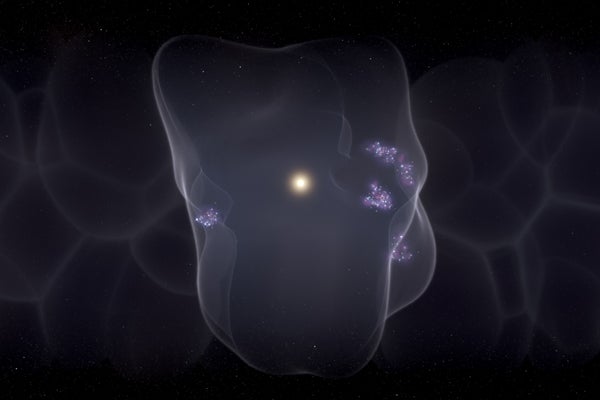
Scientists have discovered a potentially star-forming cloud, now called Eos, which is one of the largest single structures in the sky and among the closest to the sun and Earth ever to be detected.
Thomas Müller (HdA/MPIA) and Thavisha Dharmawardena (NYU)
The cloud is roughly crescent-shaped and sits on the edge of the Local Bubble, which is a volume of space where the interstellar medium is more rarefied than its surroundings, perhaps having been emptied by the shockwaves of hundreds of ancient supernovas. The sun and our solar system are passing through the Local Bubble, and have been doing so for the past five million years or so.
The cloud, named Eos after the goddess of Greek mythology who signified the dawn, contains approximately 3,400 solar masses worth of gas. It's also depleted in carbon monoxide, which is why it had gone undetected by conventional means.
Eos is predicted to disperse, or photodissociate, as a result of background photons impacting the cloud's molecules, in about 5.7 million years' time. This is too soon for it to begin forming stars, unless there is some other trigger that advances things, such as the gravitational disturbance of another passing cloud. Intriguingly, the average star-formation rate in our sun's neighborhood has been calculated at 200 solar masses per million years. Eos is losing mass to the wider interstellar medium at a rate of 600 solar masses per million years, three times the rate at which molecular gas is converted into stars. Therefore, this dispersion of molecular clouds as a result of photodissociation from light emitted by nearby stars seems to act as a feedback mechanism to regulate the rate of star formation, Burkhart's team believes. This is useful information for telling us more about the conditions needed to enable star formation in other, more distant clouds.
"When we look through our telescopes, we catch whole solar systems in the act of forming, but we don't know in detail how that happens," said Burkhart. "Our discovery of Eos is exciting because we can now directly measure how molecular clouds are forming and dissociating, and how a galaxy begins to transform interstellar gas and dust into stars and planets."
And the discovery of other, similar clouds could be just on the horizon.
"The use of the far-ultraviolet fluorescence emission technique could rewrite our understanding of the interstellar medium, uncovering hidden clouds across the galaxy and even out to the furthest detectable limits of cosmic dawn," said Dharmawardena.
Eos may not see the dawn of new stars, but its existence is testament to a greater dawn, going all the way back to near the beginning of the universe, in which stars have brought daylight to a dark cosmos.
The findings were published on April 28 in the journal Nature Astronomy.
Copyright 2025 Space.com, a Future company. All rights reserved. This material may not be published, broadcast, rewritten or redistributed.