
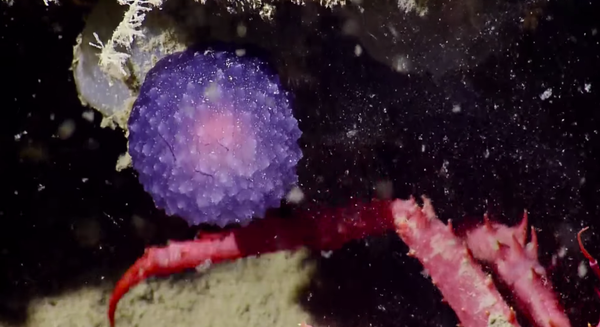
"Have a look at that dark purple blob on the left, there."
With those words, scientists aboard the Exploration Vessel Nautilus uncovered a marine mystery: a small purple orb tucked halfway under a rock off the coast of California.
Researchers are so far stumped as to what the colorful, bumpy little ball might be. Their best guess is that it might be a gastropod (a mollusk such as a snail or slug that belongs to the class Gastropoda) called a pleurobranch — and possibly a new species.
On supporting science journalism
If you're enjoying this article, consider supporting our award-winning journalism by subscribing. By purchasing a subscription you are helping to ensure the future of impactful stories about the discoveries and ideas shaping our world today.
"None of the known species of California pleurobranch are purple," said Susan Poulton, a spokeswoman for the E/V Nautilus expeditions. [Gallery: See Images of the Mysterious Purple Orb]
Oddball creature
The odd little creature, which unfurled into two lobes once it was brought onboard the ship, is about 2 inches (5 centimeters) across. It was found on July 18, during an E/V Nautilusexploration of Arguello Canyon, west of the Channel Islands National Marine Sanctuary.
A live video feed captured by cameras on the remotely operated vehicle Hercules shows the muddy ocean floor 5,301 feet (1,616 meters) down, as watching researchers remark on clams and crabs. Suddenly, the purple blob catches the scientists' attention.
"What is that?" one asks.
"I'm stumped," says another.
The researchers decided to collect the creature with the ROV's suction, briefly fending off a nearby crab. They've since sent the organism to the Harvard Museum of Comparative Zoology for analysis. They also took samples for RNA analysis and plan to conduct a DNA analysis as well.
"Confirming it's a new species will take considerable months," Poulton said.
Expedition, live
It's relatively unusual for the E/V Nautilusteam to discover a completely new species, Poulton said, though they have found organisms that they suspect are unknown to science; it just takes time to confirm that fact. More often, she said, the Nautilus researchers find organisms in areas where no one previously knew the animals lived. It may be that the purple orb is a known gastropod that simply had never been seen in California waters before, Poulton said.
The E/V Nautilus is operated by the Ocean Exploration Trust, a nonprofit organization that was founded by oceanographer Robert Ballard. Since May, the vessel has been exploring the eastern Pacific Ocean, starting off Canada's Vancouver Island and working southward. Currently, the vessel is off the coast of Los Angeles investigating the Southern California continental margin. The research team broadcasts its activities at http://www.nautiluslive.org/ and issues dive alerts on Twitter.
The live video feeds are a boon to the researchers on board, Poulton said, because scientists around the country tune in and often call their colleagues on the ship, asking them to go back to collect interesting specimens.
"We sort of sail with a science team of hundreds," Poulton said.
Copyright 2016 LiveScience, a Purch company. All rights reserved. This material may not be published, broadcast, rewritten or redistributed.