
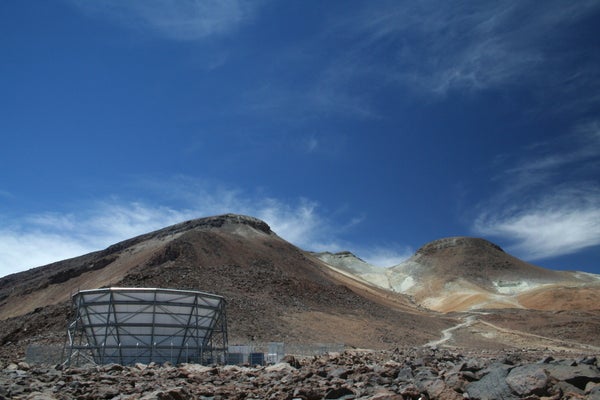

A new map of the early Universe has reinforced a long-running conundrum in astronomy over how fast the cosmos is expanding. The data—collected using a telescope in Chile’s Atacama Desert—back up previous estimates of the Universe’s age, geometry and evolution. But the findings clash with measurements of how fast galaxies are flying apart from each other, and predict that the Universe should be expanding at a significantly slower pace than is currently observed.
The Atacama Cosmology Telescope (ACT) mapped the cosmic microwave background (CMB), the radiation ‘afterglow’ of the Big Bang. The findings, based on data collected from 2013 to 2016, were posted on 15 July in two preprints on the arXiv repository.
CMB radiation comes from all directions of space, but it is not perfectly uniform: its variations across the sky reveal that regions of the early Universe differed slightly in temperature, by less than 0.03 kelvin. Over the past two decades, cosmologists have used those minute variations—together with an established theory they call the standard model—to calculate some of the key features of the Universe’s structure and evolution, including its age and the density of matter.
On supporting science journalism
If you're enjoying this article, consider supporting our award-winning journalism by subscribing. By purchasing a subscription you are helping to ensure the future of impactful stories about the discoveries and ideas shaping our world today.
Cosmologists also use the variations to predict the rate at which the Universe is currently expanding, a measure known as the Hubble constant after the US astronomer Edwin Hubble.
The European Space Agency’s Planck telescope mapped the entire CMB sky from 2009 to 2013 with unprecedented precision, and its observations are considered the gold standard of CMB cosmology. The ACT data now vindicate Planck’s findings and produce a very similar value for the Hubble constant.
But neither result matches direct measurements of the Hubble constant—a discrepancy that has become known as the Hubble-constant tension. Astronomers who use the brightness of particular types of stars and supernova explosions, collectively called standard candles, to calculate the expansion rate find that galaxies rush away from each other roughly 10% faster than the CMB maps predict.
Many researchers had hoped that as techniques became more accurate, the gap would shrink. Instead, narrowing error bars for each type of study have only made the inconsistency more significant.
The ACT is the first ground-based CMB experiment that could have challenged Planck’s results, says Erminia Calabrese, a cosmologist at Cardiff University, UK, who led the analysis of the data. The telescope’s design and location, just inside the tropics, enables it to map more of the CMB sky than other ground-based or balloon-borne telescopes, which have typically been limited to smaller regions.
Mapping the sky on a large scale is crucial for calculating the key parameters of cosmic expansion, Calabrese says. Another strength of the ACT was that an upgrade in 2013 allowed it to make precise measurements of the polarization of the CMB radiation, says principal investigator Suzanne Staggs of Princeton University in New Jersey. Polarization data reveal how galaxies in the foreground affect how the CMB travels, and help to make the cosmological measurements more precise.
“For the first time we have two data sets measured independently and with enough precision to make a comparison,” Calabrese says. Having also been a member of the Planck team, she says it was a relief to find that the two experiments’ Hubble-constant predictions agreed to within 0.3%.
This agreement between ACT and Planck on the Hubble constant is “a truly major milestone”, says Paul Steinhardt, a theoretical physicist at Princeton University. “I am very impressed by the quality of the new data and their analysis,” he adds.
“It’s always good to have independent checks, and I think this really provides it,” says Wendy Freedman, an astronomer at the University of Chicago in Illinois and a standard-candle pioneer. Adam Riess, an astronomer at Johns Hopkins University in Baltimore, Maryland, who has led much of the cutting-edge work on standard candles, says that the ACT data’s agreement with Planck is “reassuring” and “a testament to the quality of the experimenters’ work and carefulness”.
But the tension on the Hubble constant remains. Techniques developed by several teams, including one led by Freedman, could help to resolve it. Steinhardt thinks that the measurements will eventually converge as experimentalists perfect their methods.
But Riess says that perhaps it is cosmology’s standard model that is wrong instead. “My gut feeling is that there’s something interesting going on.”
This article is reproduced with permission and was first published on July 15 2020.