"Nanoflower" Design May Improve Solar Cells

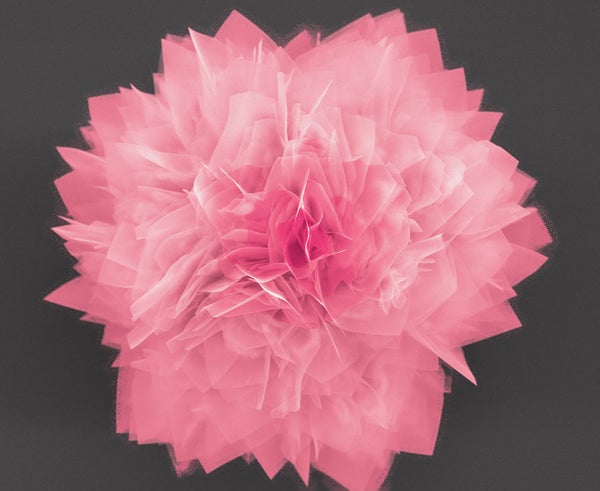
What is the best shape for nanomaterials that move energy in solar cells? When it comes to the semiconductor germanium sulfide, the answer appears to look a lot like a peony.

Courtesy of Linyou Cao

Join Our Community of Science Lovers!


On supporting science journalism

If you're enjoying this article, consider supporting our award-winning journalism by subscribing. By purchasing a subscription you are helping to ensure the future of impactful stories about the discoveries and ideas shaping our world today.


What is the best shape for nanomaterials that move energy in solar cells? When it comes to the semiconductor germanium sulfide, the answer appears to look a lot like a peony. According to new research published in the American Chemical Society's ACS Nano, such "nanoflowers" have the potential to improve solar cells and other technologies.

The key is the surface area of all those petals, which suddenly makes much more of the semiconducting material available to interact with incoming light. To make the flower shape, materials scientist Linyou Cao of North Carolina State University in Raleigh and his colleagues first vaporized a germanium sulfide powder, then blew the resulting vapor to a cooler chamber where it deposited as a thin sheet, less than 30 nanometers wide.

Laying sheet upon sheet in this way allowed the researchers to build this crystalline nano-flower, much as an origami artist might use paper to achieve a similar configuration. Cao likens the result to a marigold or carnation, which suggests that when it comes to a germanium sulfide solar cell, the guide to the proper shape for harvesting sunlight may not be a plant's leaves, but rather its flowers.

It’s Time to Stand Up for Science

If you enjoyed this article, I’d like to ask for your support. Scientific American has served as an advocate for science and industry for 180 years, and right now may be the most critical moment in that two-century history.

I’ve been a Scientific American subscriber since I was 12 years old, and it helped shape the way I look at the world. SciAm always educates and delights me, and inspires a sense of awe for our vast, beautiful universe. I hope it does that for you, too.

If you subscribe to Scientific American, you help ensure that our coverage is centered on meaningful research and discovery; that we have the resources to report on the decisions that threaten labs across the U.S.; and that we support both budding and working scientists at a time when the value of science itself too often goes unrecognized.

In return, you get essential news, captivating podcasts, brilliant infographics, can't-miss newsletters, must-watch videos, challenging games, and the science world's best writing and reporting. You can even gift someone a subscription.

There has never been a more important time for us to stand up and show why science matters. I hope you’ll support us in that mission.

Thank you,

David M. Ewalt, Editor in Chief, Scientific American

Subscribe