
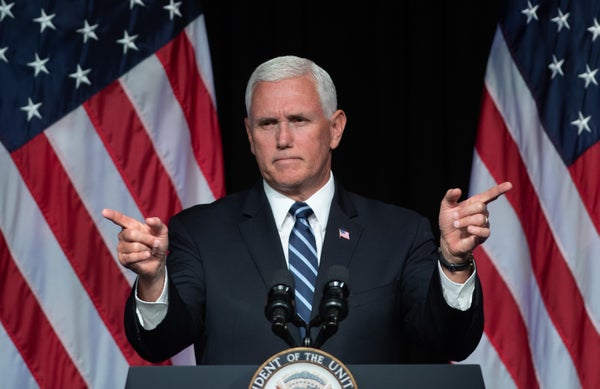
In a speech full of commendation but without much concrete substance, U.S. Vice President Mike Pence discussed the future of the country’s space policy and highlighted the importance of a moon-orbiting space station that could host U.S. astronauts by 2024.
The vice president spoke today (Aug. 23) at NASA’s Johnson Space Center in Houston after touring the facilities with Apollo 17 astronaut Jack Schmitt, who traveled on the country’s last crewed mission to the moon, in 1972.
“While our sights are once again set on our lunar neighbor, this time we’re not content with just leaving behind footprints — or even to leave at all,” Pence told the crowd of NASA employees. “The time has come, we really believe, for the United States of America to take what we have learned over these so many decades, put [NASA’s] ingenuity and creativity to work, and establish a permanent presence around and on the moon.” [Presidential Visions for Space Exploration: From Ike to Trump]
On supporting science journalism
If you're enjoying this article, consider supporting our award-winning journalism by subscribing. By purchasing a subscription you are helping to ensure the future of impactful stories about the discoveries and ideas shaping our world today.
To do that, he said, the U.S. would start with a long-term orbital platform near the moon.
“Last year, NASA began to work with American innovators to design [the Lunar] Gateway’s unique electrical propulsion system. We’re working with the Congress to provide an unprecedented $500 million to move the Lunar Orbital Platform from proposal to production,” he added. “We’re only a few short years away from launching the Gateway’s first building blocks into space, turning science fiction into science fact. And our administration’s working tirelessly to put an American crew aboard the Lunar Orbital Platform before the end of 2024.”
Pence also said that as NASA uses the Space Launch System (SLS) rocket and Orion spacecraft, which are both under development, to push toward the moon and beyond, commercial space companies could fill in the gaps closer to home. (The first test of SLS and Orion together, without a crew, is planned for 2019 or 2020.) That work, by companies like SpaceX and Boeing, will include pushing the industry forward in low Earth orbit and providing rides to the International Space Station. (Pence added that the U.S. currently pays Russia’s space program about $82 million per seat on trips to the station.)
Pence ran through the accomplishments so far of the presidential administration and the newly restarted National Space Council he chairs: resolving to reduce red tape for launches, create new policies for managing space traffic and make returning to the moon an explicit U.S. policy goal. And he discussed security in space, referring to President Donald Trump’s plan to create a Space Force to support national security off the planet.
The cancellation of previous efforts to reach the moon “said to NASA, it said to our country, to the entire world, that America was no longer serious about human space exploration,” Pence said. “We talked about going to Mars, but without the moon as a stepping stone, without stronger commercial partnerships to help us get there, a crewed mission to the Red Planet was not much more than a mirage.
“But these days are over,” he added. “America will lead mankind to the stars once again.”
Copyright 2018 SPACE.com, a Purch company. All rights reserved. This material may not be published, broadcast, rewritten or redistributed.