
The success of SpaceX’s first-ever crewed mission has NASA very optimistic about the future of human spaceflight.
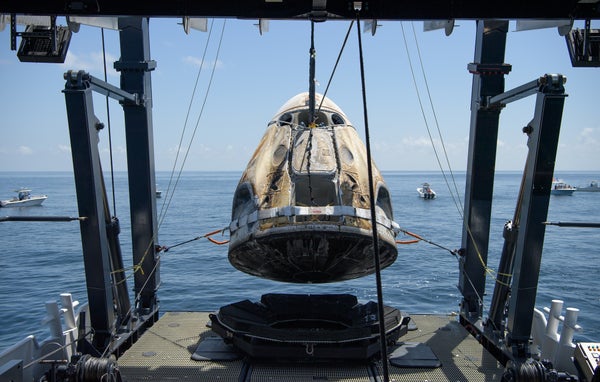
A SpaceX Crew Dragon capsule carrying NASA astronauts Bob Behnken and Doug Hurley splashed down in the Gulf of Mexico today (Aug. 2), wrapping up the company’s historic Demo-2 test flight to the International Space Station.
Demo-2’s May 30 launch was the first orbital crewed mission to depart from U.S. soil since the final flight of NASA’s space shuttle program, back in 2011. With Demo-2 now in the books, the nation is poised to make this drought a distant memory, NASA Administrator Jim Bridenstine said.
On supporting science journalism
If you're enjoying this article, consider supporting our award-winning journalism by subscribing. By purchasing a subscription you are helping to ensure the future of impactful stories about the discoveries and ideas shaping our world today.
“Today was a great victory, but it was just the beginning,” Bridenstine said in a post-splashdown news conference today.
“We are entering a new era of human spaceflight, where NASA is no longer the purchaser, owner and operator of all the hardware,” he added. “We are going to be a customer—one customer of many customers in a very robust commercial marketplace for human spaceflight to low-Earth orbit.”
NASA is the first customer for SpaceX’s astronaut-taxi services: the agency has been funding the development and testing of Crew Dragon via its Commercial Crew Program for a decade.
In 2014, NASA awarded Elon Musk’s company a $2.6 billion contract to wrap up that work and fly at least six operational missions to and from the space station using Crew Dragon and the Falcon 9 rocket. Boeing got a similar deal worth $4.2 billion, which the aerospace giant will fulfill using a capsule called CST-100 Starliner. (Starliner isn’t yet ready to carry astronauts; it must first refly an uncrewed test mission to the space station, after failing to meet up with the orbiting lab as planned in December 2019.)
SpaceX can now begin working in earnest toward its first operational mission, the four-person Crew-1, which is scheduled to launch in late September, provided an analysis of Demo-2 data turns up no red flags. And red flags seem unlikely, given well how the test flight went.
“This was an incredibly smooth mission," SpaceX president and chief operating officer Gwynne Shotwell said during today’s briefing.
She did identify two minor, fixable issues that cropped up today. The backup generator failed on GO Navigator, the recovery ship that plucked the Crew Dragon out of the water after splashdown. And levels of nitrogen tetroxide, a toxic oxidizer, remained slightly elevated around the capsule for longer than mission team members expected, spurring the recovery team to “purge” the gas before extracting Behnken and Hurley from the spacecraft.
There was a third issue as well, but it doesn’t fall at SpaceX’s feet. Private boats crowded around the Crew Dragon shortly after it landed, failing to respect the distance that the U.S. Coast Guard had established ahead of splashdown.
“That capsule was in the water for a good amount of time, and those boats just made a beeline for it,” Bridenstine said. “There are things that we’re going to look at, that we need to do better at for sure.”
The elevated levels of nitrogen tetroxide around Crew Dragon reinforce the necessity of keeping the splashdown area clear throughout the recovery process, he added. The oxidizer posed no threat to Behnken, Hurley or the recovery team, who were all prepared for this scenario. But the private boaters who came close to rubberneck and take photos almost certainly didn’t plan for it.
NASA isn’t SpaceX’s only Crew Dragon customer. Houston-based company Axiom Space has booked a trip to the space station with the capsule, with a launch targeted for sometime next year.
And U.S. space-tourism outfit Space Adventures plans to fly four passengers on Crew Dragon in 2021 or 2022. That mission won’t rendezvous with the International Space Station, instead flying higher than the orbiting lab for a jaunt lasting five days or so.
SpaceX is also working on Crew Dragon’s successor.
The company is already building and testing prototypes for its next-generation human spaceflight system, Starship, which is designed to carry humans to the moon, Mars and anywhere else they want to go. (Mars is the chief destination over the longer haul; Musk has repeatedly said he started SpaceX in 2002 mainly to help humanity colonize the Red Planet.)
Starship is in the running to be the human landing system for NASA’s Artemis program, which aims to put two astronauts on the moon by 2024 and establish a sustainable, long-term presence on and around Earth’s nearest neighbor by 2028.
NASA envisions the moon as a stepping stone to Mars, which the agency wants to reach with a crewed mission sometime in the 2030s. NASA is developing its own hardware to get astronauts to the moon and Mars—namely, a crew capsule called Orion and a giant rocket known as the Space Launch System. This duo is slated to fly together for the first time, on an uncrewed test flight around the moon, in late 2021.
Demo-2’s success brings these distant destinations a bit closer, both Bridenstine and Shotwell said.
“Today is a great day. We should celebrate what we all accomplished here today, bringing Bob and Doug back,” Shotwell said. “But we should also think about this as a springboard to doing even harder things, with the Artemis program and then, of course, moving on to Mars.”
Copyright 2020 Space.com, a Future company. All rights reserved. This material may not be published, broadcast, rewritten or redistributed.