
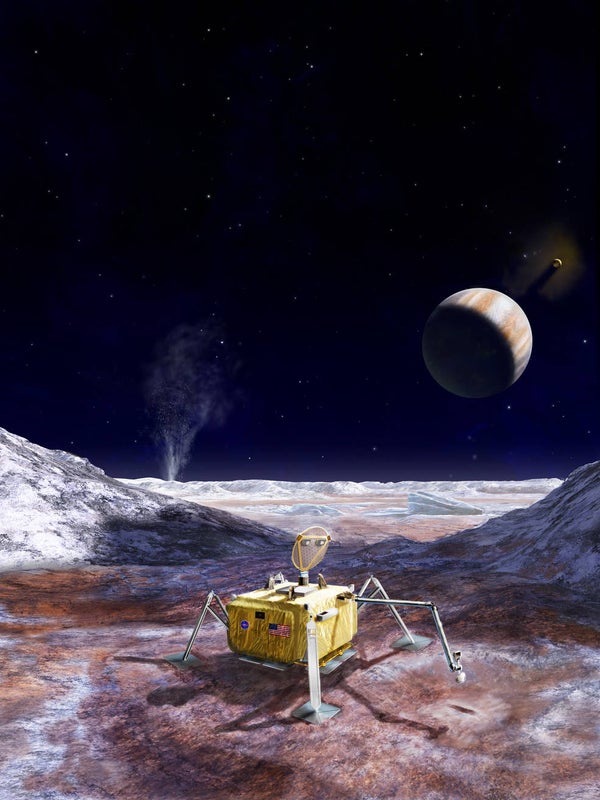
It's time for scientists to start thinking about the instruments they'd like to put on a potential life-hunting lander mission to Jupiter's ocean-harboring moon Europa, NASA officials said.
Yesterday (May 17), the space agency issued a "community announcement" about the possible Europa lander mission, telling researchers to get ready for an upcoming science-instrument competition.
"The possibility of placing a lander on the surface of this intriguing icy moon, touching and exploring a world that might harbor life, is at the heart of the Europa lander mission," Thomas Zurbuchen, associate administrator of NASA's Science Mission Directorate in Washington, D.C., said in a statement. [Photos: Europa, Mysterious Icy Moon of Jupiter]
On supporting science journalism
If you're enjoying this article, consider supporting our award-winning journalism by subscribing. By purchasing a subscription you are helping to ensure the future of impactful stories about the discoveries and ideas shaping our world today.
"We want the community to be prepared for this announcement of opportunity, because NASA recognizes the immense amount of work involved in preparing proposals for this potential future exploration," Zurbuchen added.
NASA is already working on a $2 billion mission known as Europa Clipper, which will orbit Jupiter and study Europa over the course of dozens of close flybys. The main goals of that mission, which is currently targeted for launch in the early 2020s, involve investigating the structure and composition of Europa and gauging the habitability of its subsurface ocean.
In late 2015, Congress requested that NASA study the possibility of adding a lander component to the Europa project. The space agency has since concluded that the lander would be a separate spacecraft that would launch toward the Jupiter system on its own, not with Clipper.
But the lander is still just a concept, not an approved mission. And its odds of getting off the ground are tough to gauge; the White House did not allocate any money to a Europa lander in its preliminary 2018 budget request, which was released in March.
However, NASA has money in its 2017 budget to fund the "announcement of opportunity" activities, agency officials said.
The lander-instrument competition will be a two-step process. About 10 proposals will likely be chosen to advance to "Phase A"; the investigators behind those proposals will each get about $1.5 million to develop their ideas for 12 months, NASA officials said.
"At the conclusion of these studies, NASA may select some of these concepts to complete Phase A and subsequent mission phases," the officials wrote in the same statement.
Potential instrument investigations, they added, must address one or more of the following scientific objectives:
Searching for signs of life on Europa.
Assessing the moon's habitability using techniques available only to a lander mission.
Making lander-scale characterization of Europa's surface and subsurface properties.
EDITOR'S RECOMMENDATIONS
Does Europa Have 2X Earth's Liquid Water? Very Likely! | NASA Video
Saturn’s Moon Habitable? Molecular Hydrogen Found in Enceladus’ Plume | Video
Copyright 2017 SPACE.com, a Purch company. All rights reserved. This material may not be published, broadcast, rewritten or redistributed.