
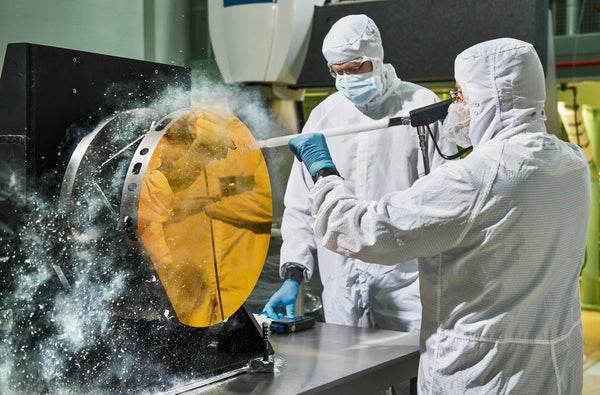
NASA has delayed the launch of its huge, highly anticipated James Webb Space Telescope by another 10 months.
The liftoff of James Webb, the successor to the agency’s iconic Hubble Space Telescope, has been pushed back from May 2020 to March 2021, NASA officials announced today (June 27). The project’s development cost has risen from $8 billion to $8.8 billion, and its total lifecycle price tag now stands at $9.66 billion, they added.
The rescheduling is the latest in a series of delays for James Webb, which NASA had originally hoped to get off the ground way back in 2007.
On supporting science journalism
If you're enjoying this article, consider supporting our award-winning journalism by subscribing. By purchasing a subscription you are helping to ensure the future of impactful stories about the discoveries and ideas shaping our world today.
“We have to get this right here on the ground before we go to space,” Thomas Zurbuchen, the associate administrator of NASA’s Science Mission Directorate, said during a news conference today. “And I just want to re-emphasize: Webb is worth the wait.”
Rocky road for a complex observatory
James Webb is a multipurpose observatory that will allow astronomers to study some of the first stars and galaxies in the universe, hunt for possible signs of life in the atmospheres of nearby alien planets, and do a variety of other high-profile work. Its primary mirror is 21.3 feet (6.5 meters) wide, compared to 7.8 feet (2.4 m) for that of Hubble.
“Webb is vital to the next generation of research beyond NASA’s Hubble Space Telescope,” NASA Administrator Jim Bridenstine said in a statement. “It’s going to do amazing things—things we’ve never been able to do before—as we peer into other galaxies and see light from the very dawn of time.”
James Webb is optimized to view the heavens in infrared light, and its instruments must therefore be kept quite cool. So the telescope will sport a giant sunshade the size of a tennis court, which will unfold after James Webb reaches its final destination, a gravitationally stable spot about 930,000 miles (1.5 million kilometers) from Earth.
The road to that destination has been quite bumpy to date. James Webb is a very complex observatory that has proven difficult for primary contractor Northrop Grumman to build and test, as the repeated delays attest.
Until relatively recently, NASA had been targeting an October 2018 launch. In September of last year, however, NASA announced that spacecraft-integration issues had forced a re-plan to spring of 2019. Then, this past March, the agency pushed the scheduled liftoff date back again, to May 2020. More time was needed to test James Webb’s intricate systems and to deal with setbacks, such as small tears in the sunshield, NASA officials said at the time.
The agency also set up an independent review board (IRB) in March to monitor the observatory’s progress and develop recommendations. The IRB submitted its report to NASA on May 31, and the agency wrapped up its response to that report yesterday (June 26). (You can read both the report and NASA’s response here.)
The IRB traced the 29-month delay (from a targeted launch date of October 2018 to March 2021) to five factors: human error, “embedded problems,” excessive optimism, systems complexity, and lack of experience in key areas, such as sunshade development.
IRB chairman Tom Young laid out some of the most significant human errors during today’s news conference. Technicians used the wrong solvent to clean propulsion valves; employed improper wiring that caused excessive voltage to be applied to transducers; and improperly installed sunshield-cover fasteners ahead of a key test, he said.
“All simple fixes that were not implemented resulted in approximately a 1.5-year schedule delay, at a cost of about $600 million,” Young said today.
Going forward
The IRB report was key in NASA’s latest James Webb re-plan, agency officials said. Indeed, the review panel made 32 separate recommendations for the observatory’s development going forward, 30 of which NASA fully agrees with, Zurbuchen said. (The agency is still considering the other two, he added.)
Crucially, the IRB did not recommend pulling the plug on James Webb.
“With all the factors that I’ve discussed considered, the IRB believes that JWST should continue, because of the compelling science, and because of JWST’s national importance,” Young said.
The bump in the mission’s development cost from $8 billion to $8.8 billion may complicate that vision, however. The former number was a cap imposed by Congress, meaning that James Webb needs another signoff from Capitol Hill to proceed.
“We submit our final ’breach report’ to Congress this week,” NASA associate administrator Steve Jurczyk said during today’s news conference. “And then, it is true that Congress will have to reauthorize Webb through this next cycle of appropriations.”
Copyright 2018 SPACE.com, a Purch company. All rights reserved. This material may not be published, broadcast, rewritten or redistributed.