
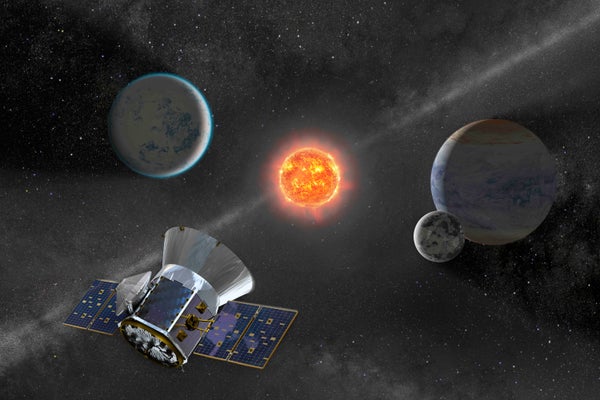
Just nine months after its launch, NASA’s Transiting Exoplanet Survey Satellite (TESS) has found at least eight planets, with more than 300 planetary candidates waiting in the wings.
A bizarre planet at least 23 times the mass of Earth, unveiled on 7 January, is among the confirmed planets—some of which have been reported before.
The newly described planet whizzes around its star on a stretched-out orbit once every 36 days, says Xu Chelsea Huang, a TESS scientist at the Massachusetts Institute of Technology (MIT) in Cambridge. Even stranger, there are hints that another planet not much bigger than Earth is orbiting closer to the star.
On supporting science journalism
If you're enjoying this article, consider supporting our award-winning journalism by subscribing. By purchasing a subscription you are helping to ensure the future of impactful stories about the discoveries and ideas shaping our world today.
How a small inner planet stays on that path as a bigger planet lurches on an elliptical orbit around the same star is a mystery. “This is the most extreme system with this type of architecture,” Huang says. “We don’t know how that could form.” The star is known as HD 21749 and lies 16 parsecs (53 light years) from Earth in the constellation Reticulum.
Huang reported the findings at a meeting of the American Astronomical Society in Seattle, Washington.
A catalogue of oddities
TESS’s other discoveries include a super-hot world, LHS 3844 b, that whirls around its star—a red dwarf only 15% the size of the Sun—every 11 hours. Details on another 20 to 30 planets discovered by TESS are on the verge of being published, Huang says.
TESS works better than team members had dared to dream, says George Ricker, a physicist at MIT and the mission’s principal investigator. Its four cameras can see objects 20% fainter, and focus more sharply, than originally expected.
The spacecraft also does more than hunt planets. Mission scientists have studied 101 stars that brightened suddenly, probably because they were exploding supernovae, says Michael Fausnaugh, an astronomer at MIT. Because TESS stares non-stop at one slice of the sky for 27 days, then moves to a neighbouring slice, it captures an unprecedented view of these exploding stars as they brighten and then dim.
“Based on the brightness and shape of that flare, there’s a lot of science that can be done,” Fausnaugh says. For instance, astronomers can scrutinize the way in which the light increases for clues to the type of star that exploded to create a particular flash. TESS discovered six supernovae in just its first month of observing; its predecessor, NASA’s Kepler space telescope, discovered five over the course of four years, Fausnaugh says.
TESS is in the process of scanning the entire southern sky, after which it will turn and canvass the northern sky.
The spacecraft could conceivably keep working for decades, Ricker says. His team is now writing a proposal to NASA asking that TESS’s mission be extended past its initial two years. That deadline for the proposal was 1 February—but the ongoing partial US government shutdown means Ricker isn’t sure how that timing could change.
This article is reproduced with permission and was first published on January 8, 2019.