

The changes spaceflight induces in astronauts are much more than skin deep.
Space travel strongly affects the way genes are expressed, or turned on and off, preliminary results from NASA's "Twins Study" have revealed.
"Some of the most exciting things that we've seen from looking at gene expression in space is that we really see an explosion, like fireworks taking off, as soon as the human body gets into space," Twins Study principal investigator Chris Mason said in a statement. [The Human Body in Space: 6 Weird Facts]
On supporting science journalism
If you're enjoying this article, consider supporting our award-winning journalism by subscribing. By purchasing a subscription you are helping to ensure the future of impactful stories about the discoveries and ideas shaping our world today.
"With this study, we've seen thousands and thousands of genes change how they are turned on and turned off," added Mason, who's based at Weill Cornell Medicine, Cornell University's medical school. "This happens as soon as an astronaut gets into space, and some of the activity persists temporarily upon return to Earth."
Specifically, Mason and his team found an increase in methylation, which involves slapping methyl groups onto stretches of DNA. This process commonly inhibits activation of the genes involved. (A methyl group consists of a carbon atom bonded to three hydrogen atoms.)
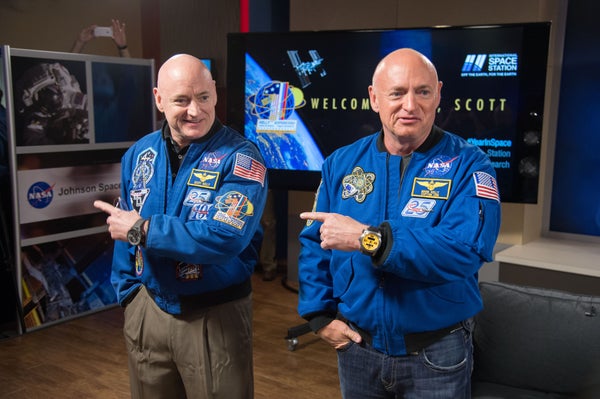
The Twins Study centers on former NASA astronauts Scott and Mark Kelly, who are identical twins and therefore share a DNA profile.
Scott Kelly and cosmonaut Mikhail Kornienko lived aboard the International Space Station (ISS) from March 2015 through March 2016, completing an unprecedented 11-month mission. (Most stints aboard the orbiting lab last five to six months.) Mark Kelly stayed on Earth the entire time, serving as a control against which to measure the changes that spaceflight may have induced in Scott.
Researchers are still assessing such changes, across the 10 separate investigations that constitute the broader Twins Study. Final results are expected to be published next year, NASA officials said.
"This study represents one of the most comprehensive views of human biology," Mason said. "It really sets the bedrock for understanding molecular risks for space travel as well as ways to potentially protect and fix those genetic changes."
Spaceflight also causes changes to astronauts' bodies on the macro level, including muscle atrophy, decreased bone density and visual deterioration. Scientists have long known about such effects, and astronauts already take measures to mitigate some of them. For example, vigorous exercise is a part of every crewmember's daily routine aboard the ISS, as a way to combat bone and muscle wasting.
NASA is keen to better understand all of the physiological and psychological impacts of spaceflight, so it can better prepare for crewed missions to Mars and other distant destinations, agency officials have said.
EDITOR'S RECOMMENDATIONS
How the Epic One-Year Space Station Mission Works (Infographic)
How 1-Year Space Mission Affected Astronaut Twin Scott Kelly: Early Results
Copyright 2017 SPACE.com, a Purch company. All rights reserved. This material may not be published, broadcast, rewritten or redistributed.