
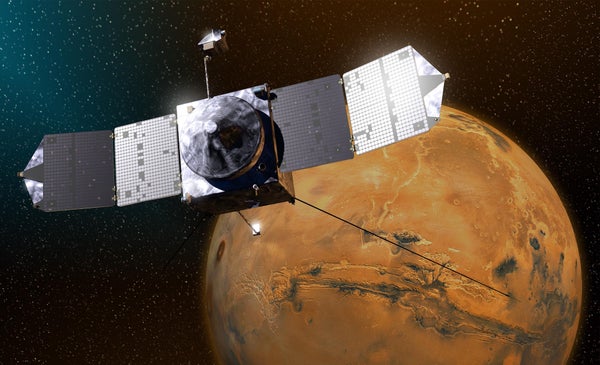
One of NASA’s workhorse spacecraft in orbit around Mars has fallen silent, leaving agency personnel scrambling to troubleshoot the issue.
The Mars Atmosphere and Volatile Evolution (MAVEN) mission launched in November 2013 and has been operating at the Red Planet since September 2014. Like many NASA missions, MAVEN has lasted well beyond its original design lifetime, which was one year. But on December 6 something apparently went wrong while the spacecraft was on the far side of Mars, the side of the planet that faces away from Earth.
“Telemetry from MAVEN had showed all subsystems working normally before it orbited behind the Red Planet,” wrote NASA officials in a statement posted on December 9. “After the spacecraft emerged from behind Mars, NASA’s Deep Space Network did not observe a signal.”
On supporting science journalism
If you're enjoying this article, consider supporting our award-winning journalism by subscribing. By purchasing a subscription you are helping to ensure the future of impactful stories about the discoveries and ideas shaping our world today.
The MAVEN mission’s primary science goal has been to study the Martian atmosphere and the way it is affected by the solar wind, the constant stream of charged particles that flows off of our sun and across space.
As a secondary task, the spacecraft also serves as one of four spacecraft that relay communications between Earth and missions on the Martian surface; notably these missions include the Curiosity and Perseverance rovers. The European Space Agency’s (ESA’s) Exomars Trace Gas Orbiter, which arrived at Mars in 2016, handles the bulk of these transmissions, followed by the aging MAVEN. Two even older NASA spacecraft—the Mars Reconnaissance Orbiter and 2001 Mars Odyssey—combine to round out the relay work. ESA’s Mars Express is also on hand as a backup.
MAVEN’s troubles highlight the fact that even the network’s newest member has already been operating in space for nearly a decade, raising the risk of multiple cascading failures.
Realizing the peril of stretching this network too thin, NASA has pursued various next-generation orbiters for Mars communications for decades, but most of these projects have gone nowhere. One such scheme, provisionally dubbed the Mars Telecommunications Orbiter, was first conceived more than 20 years ago and subsequently canceled. It was then revived earlier this year with a $700-million allocation as part of the Trump administration’s so-called One Big Beautiful Bill Act. Even if the mission materializes, it is years away from launch. MAVEN, meanwhile, is built into the agency’s plans to support Mars Sample Return, the already troubled mission meant to retrieve rock samples gathered by the Perseverance rover.
This latest glitch isn’t the first time MAVEN has given NASA a serious scare. In 2022 the mission spent three months in safe mode, which occurs when a spacecraft has an issue that it can’t solve independently. That potentially fatal trouble was caused by the spacecraft’s inertial measurement units, which keep MAVEN pointed in the proper orientation. The mission team ultimately had to update the spacecraft with a whole new program for staying stable.