
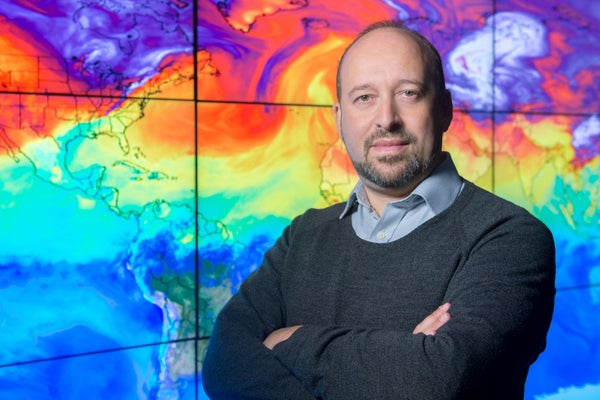
NASA announced yesterday that Gavin Schmidt, an expert in climate modeling, will become the space agency's first senior climate adviser.
The new NASA position underscores the Biden administration's push to integrate climate policy throughout the federal government. Schmidt, director of NASA's Goddard Institute for Space Studies, will serve in an acting role until he receives a permanent appointment, agency officials said.
“The appointment of Gavin Schmidt will help ensure that the Biden Administration has the crucial data to implement and track its plan toward the path to achieve net-zero emissions economy-wide by 2050, and a healthier, safer, more prosperous planet for our children,” said acting NASA Chief of Staff Bhavya Lal in a statement.
On supporting science journalism
If you're enjoying this article, consider supporting our award-winning journalism by subscribing. By purchasing a subscription you are helping to ensure the future of impactful stories about the discoveries and ideas shaping our world today.
Schmidt said in an interview with E&E News that he plans to use the position to incorporate science into policymaking and to educate the public on climate change.
“It's a point person who can kind of draw all the strings together and have them be available for the rest of the administration's climate push and for the public as well,” he said. “There's a number of things that the administration has asked the agency to do climatewise, I imagine, that will be in my purview.”
While the early days of the administration have seen an expansive focus on climate policy, Biden has not yet named a NASA administrator nor a head for NOAA, the nation's two premiere science agencies.
Schmidt, who has a doctorate in applied mathematics from University College London, is an expert in the modeling of past, current and future climate conditions. He has authored or co-authored more than 150 peer-reviewed papers.
Schmidt was often a target of Trump allies who did not like his outspoken advocacy for climate research. NASA, however, was one of the few areas of the federal government where climate research was largely left alone by the Trump administration.
NASA uses more than two dozen satellites and scientific instruments to observe and track key climate data, according to the agency. In his new role, Schmidt will be expected to communicate the agency's research with the public and policymakers, and to work with the White House Office of Science and Technology Policy and the Office of Management and Budget.
Schmidt's appointment will help the Biden administration develop the scientific backing to carry out its plan to achieve net-zero emissions by 2050, Lal said.
“The complexities of climate processes still are not fully understood, and climate adaptation and mitigation efforts cannot succeed without robust climate observations, data and research,” Lal said.
Science can offer more than just information about rising carbon emissions and the need to mitigate them, Schmidt said. For example, there is room to broaden NASA's research, to explore the co-benefits and consequences of water resources and crop yields, he said.
Schmidt said there is still plenty to be done in improving climate science “in the service of making better decisions.”
“Policies can't be implemented in a vacuum, and you want to be able to make policy choices in the light of the best science that tells you what the consequences of those choices are going to be,” Schmidt said.
Reprinted from E&E News with permission from POLITICO, LLC. Copyright 2021. E&E News provides essential news for energy and environment professionals.