NASA Orbiter Maps Asteroid Vesta in Unprecedented Detail
The Dawn spacecraft, which entered orbit around the main-belt asteroid Vesta in July, has just spiraled in for a closer look.
NASA/JPL-Caltech/UCLA/MPS/DLR/IDA
Join Our Community of Science Lovers!
On supporting science journalism
If you're enjoying this article, consider supporting our award-winning journalism by subscribing. By purchasing a subscription you are helping to ensure the future of impactful stories about the discoveries and ideas shaping our world today.
The Dawn spacecraft, which entered orbit around the main-belt asteroid Vesta in July, has just spiraled in for a closer look. Earlier this month the NASA orbiter entered a low-altitude mapping orbit, swooping down to about 200 kilometers above the surface of the asteroid to capture high-resolution imagery of the odd-shaped body. Dawn had previously mapped Vesta from an altitude of 680 kilometers.
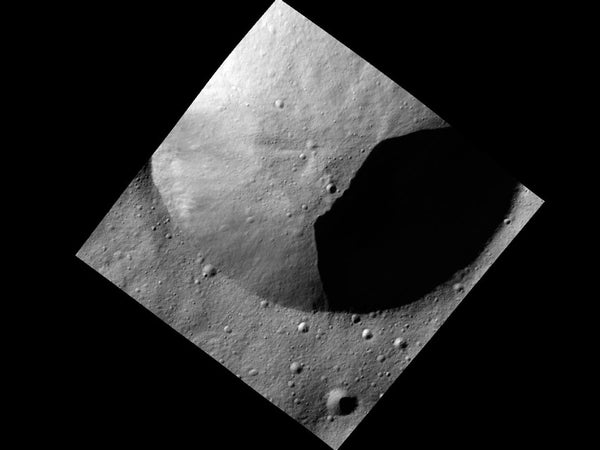
The orbiter photographed the partially shadowed, relatively fresh impact crater shown above on December 13, shortly after the start of the low-altitude observing campaign. The region surveyed in the image is 18 kilometers on a side; Vesta itself is about 560 kilometers in diameter. The crater is in the asteroid's ancient, heavily pocked northern hemisphere. In the south, where a large impact resurfaced a large swath of Vesta billions of years ago, the terrain appears to be significantly younger.
Next year Dawn will move deeper into the asteroid belt to its next target, the dwarf planet Ceres.
It’s Time to Stand Up for Science
If you enjoyed this article, I’d like to ask for your support. Scientific American has served as an advocate for science and industry for 180 years, and right now may be the most critical moment in that two-century history.
SciAm always educates and delights me, and inspires a sense of awe for our vast, beautiful universe. I hope it does that for you, too.
If you subscribe to Scientific American, you help ensure that our coverage is centered on meaningful research and discovery; that we have the resources to report on the decisions that threaten labs across the U.S.; and that we support both budding and working scientists at a time when the value of science itself too often goes unrecognized.