
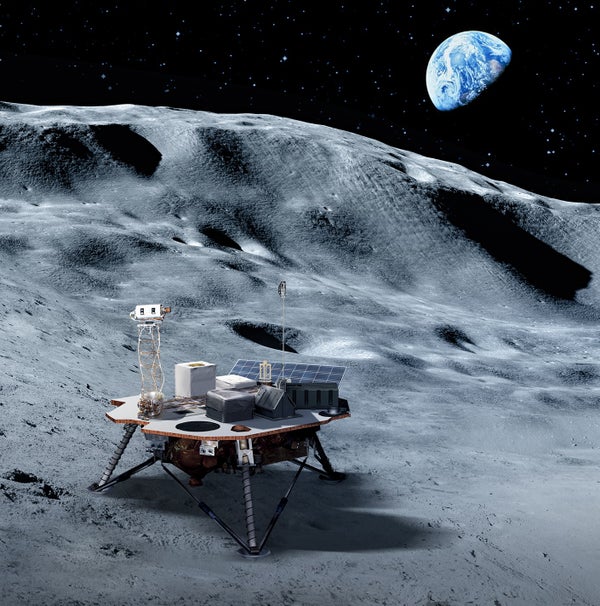
NASA has chosen the first commercial companies that will carry the agency’s equipment to the moon during its lead-up to a human landing in 2024: Astrobotic, Intuitive Machines and Orbit Beyond.
The companies will build moon landers to ferry NASA science experiments and technology demonstrations to the lunar surface. Those flights will be the first step of the agency’s ambitious Artemis program to land humans on the moon in 2024. The first mission, by Orbit Beyond, will launch in September 2020. The other two will launch in the summer of 2021.
“This is truly exciting, a new way for us at NASA to do business,” Thomas Zurbuchen, the head of NASA’s science mission directorate, said today (May 31) during the announcement at agency’s Goddard Space Flight Center in Maryland. “We can’t wait to do the science that we want to do with instruments that we’re developing right now—science that in many cases even five years ago we didn’t know how to ask questions about. This is how urgent this is.”
On supporting science journalism
If you're enjoying this article, consider supporting our award-winning journalism by subscribing. By purchasing a subscription you are helping to ensure the future of impactful stories about the discoveries and ideas shaping our world today.
Astrobotic, Intuitive Machines and Orbit Beyond will each carry a selection of NASA payloads that are intended either to address scientific questions about the moon or to test new technology that engineers are developing to advance space exploration.
NASA is providing each company with money to work on their landers: $79.5 million to Astrobotic, $77 million to Intuitive Machines and $97 million to Orbit Beyond.
NASA has not yet decided precisely which payloads will fly on which lander; the agency intends to do so later this year. Astrobotic has said its Peregrine lander will carry up to 14 payloads for NASA as well as 14 experiments for other customers (for a total of 28 payloads in all. Intuitive Machines will fly five payloads on its Nova-C lander, with Orbit Beyond carrying four payloads on its own Z-01 lander.
But each company’s lander will be carrying more than just NASA’s payloads. Orbit Beyond showed off a small demo rover as well as its lander model during the event NASA held to announce its commercial partners. Astrobotic also said it plans to carry rovers on its lunar lander.
Two of the selected companies are planning to launch their missions two years from now.
Astrobotic plans to launch its lander in June 2021 and touch down in July 2021; Intuitive Machines to both launch and land in July 2021. Orbit Beyond is pushing the timeline significantly more: the company has told NASA it can land on the moon on Sept. 27, 2020.
Today’s announcement follows the selection of nine finalist companies, which were announced in November. At the time, NASA did not offer any details about specific criteria that guided their choices.
Since that announcement, President Donald Trump’s administration has aggressively condensed NASA’s timeline for getting back to the moon, moving the goal for a human landing from 2028 to 2024.
Zurbuchen spoke in front of models of each of the three selected landers in the very same room in which NASA engineers constructed the Hubble Space Telescope and assembled the mirror of the James Webb Space Telescope, which is also due to launch in 2021.
Today’s announcement follows another substantial commercial partnership decision from NASA regarding its moon program.
On May 23, NASA announced that it had selected Maxar to build the power and propulsion element of the Gateway, a lunar-orbiting station meant to ask as a platform for missions bound for the moon’s surface. The space agency is also evaluating six potential designs for habitat modules to house astronauts on the Gateway.
Copyright 2019 Space.com, a Future company. All rights reserved. This material may not be published, broadcast, rewritten or redistributed.