NASA Mulls Ending Space Station Crew-11 Mission Early after Astronaut Suffers Medical Issue

NASA may bring some of the ISS’s crew home earlier than planned after one member experienced a medical issue just hours before two astronauts were due to complete a space walk outside the station on Wednesday

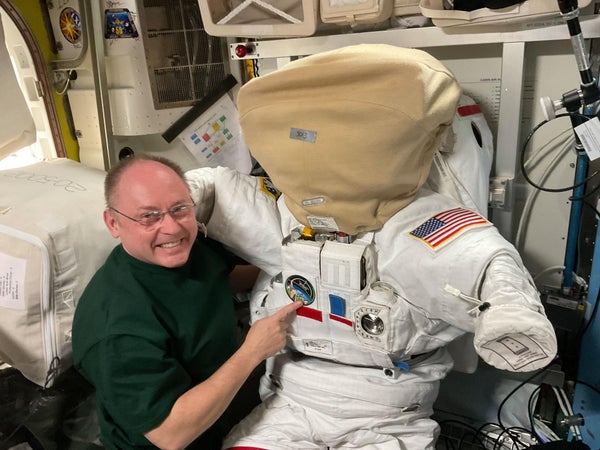
NASA astronaut Mike Fincke poses next to a spacesuit. The helmet is secured with a protective cover designed to prevent scratches and contamination when the suit is not in use, ensuring the visor remains clear for spacewalks.

NASA astronaut Mike Fincke poses next to a spacesuit inside the International Space Station’s Quest Airlock.

NASA

Join Our Community of Science Lovers!

On Thursday NASA revealed it is considering bringing crew members onboard the International Space Station (ISS) back to Earth earlier than planned after an unidentified astronaut experienced a medical issue on Wednesday.

NASA has said the crew member is in stable condition.

“Safely conducting our missions is our highest priority, and we are actively evaluating all options, including the possibility of an earlier end to Crew-11’s mission,” the agency said in a statement. More updates are expected in the next 24 hours, it said.


On supporting science journalism

If you're enjoying this article, consider supporting our award-winning journalism by subscribing. By purchasing a subscription you are helping to ensure the future of impactful stories about the discoveries and ideas shaping our world today.


The Crew-11 mission consists of NASA astronauts Zena Cardman and Mike Fincke, Russian cosmonaut Oleg Platonov and Japanese astronaut Kimiya Yui. The quartet launched on August 1, 2025, onboard a SpaceX Crew Dragon capsule, and they were expected to remain in orbit for at least six and a half months. That would place their scheduled return in mid-February 2026, following the arrival of the Crew-12 mission.

The announcement that NASA is considering changing that schedule came after the agency delayed a planned spacewalk from the ISS just hours before two astronauts were due to exit the orbiting laboratory.

In another statement, the agency said that “a medical concern with a crew member that arose Wednesday afternoon” caused the postponement. The announcement came just four hours after NASA reported that the space station crew had concluded preparations for the endeavor, which is more formally known as an extravehicular activity, or EVA. Citing medical privacy, NASA has not provided any details about which astronaut is affected or the nature of the situation.

Fincke and Cardman were due to exit the station around 8 A.M. EST on January 8 for a six-and-a-half-hour project to install and prepare some new hardware for the future rollout of a solar array. If time had permitted, they were also expected to take photographs of hardware and to sample of microorganisms living on the station’s exterior.

The four Crew-11 astronauts are joined on the ISS by NASA astronaut Chris Williams and Russian cosmonauts Sergey Kud-Sverchkov and Sergei Mikaev, who arrived in November 2025.

Editor’s Note (1/8/26): This story was updated to include new information from NASA regarding this situation. This is a breaking news story and may be updated further.

Meghan Bartels is a science journalist based in New York City. She joined Scientific American in 2023 and is now a senior reporter there. Previously, she spent more than four years as a writer and editor at Space.com, as well as nearly a year as a science reporter at Newsweek, where she focused on space and Earth science. Her writing has also appeared in Audubon, Nautilus, Astronomy and Smithsonian, among other publications. She attended Georgetown University and earned a master’s degree in journalism at New York University’s Science, Health and Environmental Reporting Program.

More by Meghan Bartels

It’s Time to Stand Up for Science

If you enjoyed this article, I’d like to ask for your support. Scientific American has served as an advocate for science and industry for 180 years, and right now may be the most critical moment in that two-century history.

I’ve been a Scientific American subscriber since I was 12 years old, and it helped shape the way I look at the world. SciAm always educates and delights me, and inspires a sense of awe for our vast, beautiful universe. I hope it does that for you, too.

If you subscribe to Scientific American, you help ensure that our coverage is centered on meaningful research and discovery; that we have the resources to report on the decisions that threaten labs across the U.S.; and that we support both budding and working scientists at a time when the value of science itself too often goes unrecognized.

In return, you get essential news, captivating podcasts, brilliant infographics, can't-miss newsletters, must-watch videos, challenging games, and the science world's best writing and reporting. You can even gift someone a subscription.

There has never been a more important time for us to stand up and show why science matters. I hope you’ll support us in that mission.

Thank you,

David M. Ewalt, Editor in Chief, Scientific American

Subscribe