
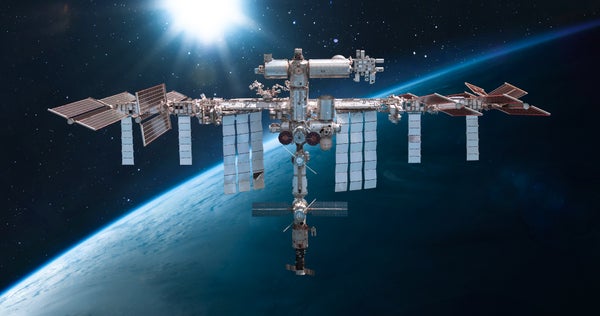
NASA is revving up its plans for a successor to the International Space Station (ISS). On Tuesday agency officials announced that a formal request for information would open on March 25, kicking off a race for private space industry players to weigh in on potential future stations.
NASA has long said that it will not build another space station itself. It is instead intent on supporting the construction of commercial outposts that NASA astronauts would be able to visit while the agency focuses its efforts on destinations farther in space. But despite a lot of space start-ups aiming to build orbiting habitats, no commercial space station has yet materialized, and NASA leadership is losing patience.
At a press conference later on Tuesday, NASA administrator Jared Isaacman said the agency was taking the “sober view.”
On supporting science journalism
If you're enjoying this article, consider supporting our award-winning journalism by subscribing. By purchasing a subscription you are helping to ensure the future of impactful stories about the discoveries and ideas shaping our world today.
Officials on Tuesday said that the agency is expanding its approach to fostering independent stations by considering proposals to build new orbital outposts directly onto the ISS. In this scenario, NASA would procure what it is calling a “Core Module” to attach to the space station and host individual commercial modules.
READ MORE: It’s Nearly Time to Say Goodbye to the International Space Station. What Happens Next?
Once docked, these fledgling stations could be tested thoroughly before they would detach to fly independently. From there, NASA envisions that it will be just one of many customers that will make use of commercial space stations—and that they will allow the agency to retain access to low-Earth orbit beyond the ISS’s lifetime, which is currently set to end in 2030.
Any awardees under the program would presumably join existing partners that are already working with NASA to develop commercial stations. These include Texas-based Axiom Space, Jeff Bezos’s Blue Origin, space industry powerhouse Northrop Grumman and long-standing ISS partner Nanoracks.
“Let’s be clear, the International Space Station has an end date. It’s absolutely unavoidable. We have to all arrive at that exact end date with all of our international partners. But it will happen, which means we must work with industry to have a replacement space station,” Isaacman said.
The clock is ticking: the ISS is already operating long beyond its design lifetime, and experts are concerned that an anomaly may send the massive laboratory tumbling uncontrolled out of the sky. In the summer of 2024 NASA hired SpaceX to convert its workhorse Dragon capsule into a supercharged vehicle capable of delicately maneuvering the ISS to burn up in Earth’s atmosphere.
Meanwhile a key congressional committee is pushing for two extra years of ISS operations in a call to prevent the agency from retiring the space station before a replacement is working. At the same press conference, Lori Glaze, acting associate administrator of NASA’s Exploration Systems Development Mission Directorate, said that the agency does have the technical ability to extend the lifetime of the station but that its objective was to foster commercially operated stations by 2030.
Editor’s Note (3/24/26): This story was updated with quotes from a NASA press conference on Tuesday.