
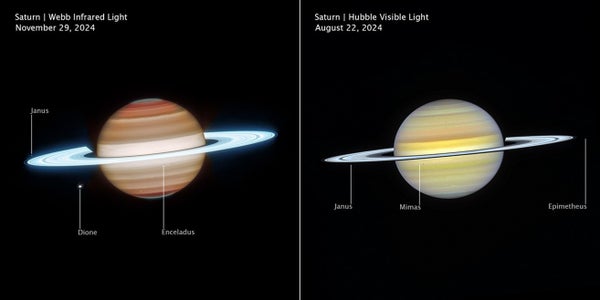
A new cache of images reveal the planet Saturn in spectacular detail, capturing the gas giant in both visible and infrared light. The images, which were taken by NASA’s James Webb Space Telescope (JWST) and Hubble Space Telescope, show the planet’s turbulent atmosphere, offering the “most comprehensive view of Saturn to date,” NASA wrote in a blog post.
Hubble captured the planet’s reflected visible light and highlighted Saturn’s iconic yellow hues—which are, in part, a product of the sunlight-reflecting ammonia crystals and hydrocarbons such as methane in its atmosphere. JWST, meanwhile, looked at the planet’s infrared light to peer deeper into the layers of its atmosphere. The two telescopes were launched to space more than 31 years apart—Hubble in April 1990 and JWST in December 2021. But in concert, they offer complimentary data and imagery that can highlight features of the universe in new detail.

An infrared view of Saturn, captured on November 29, 2024, by NASA’s James Webb Space Telescope.
NASA/ESA/CSA/STScI (image); Joseph DePasquale/STScI (image processing)
On supporting science journalism
If you're enjoying this article, consider supporting our award-winning journalism by subscribing. By purchasing a subscription you are helping to ensure the future of impactful stories about the discoveries and ideas shaping our world today.
“Together, scientists can effectively ‘slice’ through Saturn’s atmosphere at multiple altitudes, like peeling back the layers of an onion,” NASA said in its blog post, which accompanied the images. “Each telescope tells a different part of Saturn’s story, and the observations together help researchers understand how Saturn’s atmosphere works as a connected three-dimensional system.”

A visible-light image of Saturn, captured on August 22, 2024, by NASA’s Hubble Space Telescope.
NASA/ESA/STScI/Amy Simon/NASA-GSFC/Michael Wong/U.C. Berkeley (image); Joseph DePasquale/STScI (image processing)
The images reveal the turbulence within Saturn’s atmosphere, including jet streams, the remnants of storms and, in JWST’s images, a mysterious greenish hue around its poles—possibly a product of atmospheric gasses or evidence of “auroral activity” similar to the aurora borealis and aurora australis we see on Earth. Saturn’s rings of dust and rocky ice, lit up by the sun, are especially striking.
Hubble has observed Saturn for years, but the new observations and combined power of the venerable telescope and JWST will help astronomers better understand how the planet’s mysterious atmosphere evolves over time.