
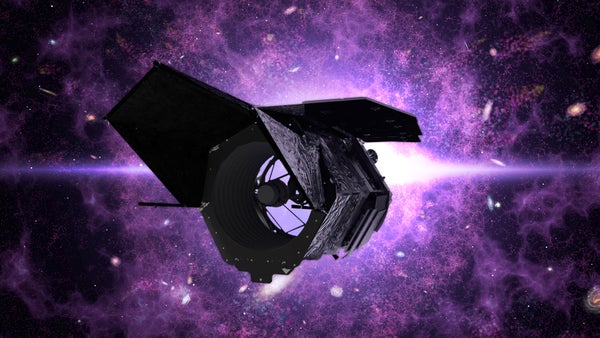
NASA has renamed its Wide Field Infrared Survey Telescope (WFIRST), a flagship observatory set to launch in 2025, to honor the renowned astronomer Nancy Grace Roman, also known as the "mother of Hubble."
The Nancy Grace Roman Space Telescope—or Roman Space Telescope for short—will help astronomers answer some of the biggest questions of cosmology, like why the universe is expanding at an accelerating rate.
By studying how the distribution of galaxies throughout the universe has changed over time, the telescope will reveal how the universe’s expansion is driven by dark energy, a mysterious form of energy that makes up roughly two-thirds of the energy in the universe. The mission will also find and study exoplanets, or worlds orbiting stars beyond our solar system.
On supporting science journalism
If you're enjoying this article, consider supporting our award-winning journalism by subscribing. By purchasing a subscription you are helping to ensure the future of impactful stories about the discoveries and ideas shaping our world today.
With its 7.9-foot (2.4 meters) primary mirror, the Roman Space Telescope is about the same size as the Hubble Space Telescope. It will be able to capture deep-space images with the same resolution as Hubble, but its field of view is 100 times wider, allowing it to image more of the sky in a shorter amount of time.
Nancy Grace Roman earned the nickname "the mother of Hubble" for her pioneering work on the iconic Hubble telescope, which launched into orbit in 1990. She became NASA’s first chief of astronomy in 1960 and was the first woman to hold an executive position at NASA. She oversaw the planning of Hubble’s mission and led the drive to convince Congress to fund it.
"It is because of Nancy Grace Roman’s leadership and vision that NASA became a pioneer in astrophysics and launched Hubble, the world’s most powerful and productive space telescope," NASA Administrator Jim Bridenstine said in a statement. "I can think of no better name for WFIRST, which will be the successor to NASA’s Hubble and Webb Telescopes."
Although Roman retired from NASA in 1979, long before the WFIRST mission was even proposed, her work with Hubble laid the foundation for future space telescopes, like the James Webb Space Telescope and the newly named Roman Space Telescope.
"Dr. Roman really deserves to be permanently associated with this amazing mission that she really helped enable in a direct fashion, and I’m so delighted to have that name there as a lasting legacy to this amazing person," Thomas Zurbuchen, the associate administrator of NASA’s Science Mission Directorate, said during a live webcast of the announcement on NASA TV today (May 20). "Nancy Grace Roman deserves a place in the heavens she studied and opened for so many," he added.
Roman passed away in 2018 at the age of 95. She was immortalized as a minifigure in Lego’s "Women of NASA" building set, which was released in 2017
Copyright 2020 Space.com, a Future company. All rights reserved. This material may not be published, broadcast, rewritten or redistributed.