
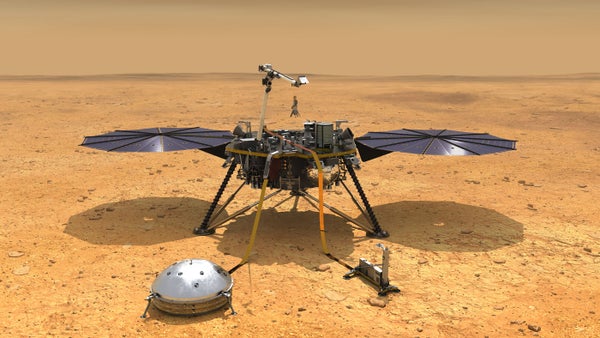
The first Mars landing in more than six years is just a week away.
NASA's $850 million InSight lander will arrive at the Red Planet on the afternoon of Nov. 26, hopefully amid a flurry of celebratory whoops akin to those elicited by the successful touchdown of the Curiosity Mars rover on Aug. 5, 2012.
But success is far from guaranteed. [NASA's InSight Mars Lander: 10 Surprising Facts]
On supporting science journalism
If you're enjoying this article, consider supporting our award-winning journalism by subscribing. By purchasing a subscription you are helping to ensure the future of impactful stories about the discoveries and ideas shaping our world today.
"Although we've done it before, landing on Mars is hard, and this mission is no different," Rob Manning, chief engineer at NASA's Jet Propulsion Laboratory (JPL) in Pasadena, California, said in a recent video about InSight's upcoming landing.
"It takes thousands of steps to go from the top of the atmosphere to the surface, and each one of them has to work perfectly to be a successful mission," Manning added.
The most crucial steps for InSight include aligning itself to hit the Martian atmosphere at precisely a 12-degree angle (any shallower, and it will bounce off; any steeper, and it will burn up); deploying its supersonic parachute and then its landing legs; and firing up its descent engines for the final touchdown.
All of this happens within a mere 6 minutes—InSight's travel time in the Red Planet air. (Curiosity's "7 minutes of terror" entry, descent and landing sequence lasted a bit longer because the heavy rover employed a different touchdown strategy: It was lowered to the Martian surface on cables by a rocket-powered sky crane.)
InSight will land not far from Curiosity, on a flat, boring plain called Elysium Planitia.
"If Elysium Planitia were a salad, it would consist of romaine lettuce and kale—no dressing," InSight principal investigator Bruce Banerdt, of JPL, said in a statement. "If it were an ice cream, it would be vanilla."
But Elysium Planitia's blandness is a feature, not a bug. InSight will investigate Mars' interior, so mission team members don't much care about interesting surface features. Indeed, mountains and canyons and crags are unwelcome, as they would just make a safe landing more difficult.
InSight will do its science work with two main instruments—a burrowing heat probe and a suite of supersensitive seismometers. The data gathered by this gear will reveal a great deal about Mars' internal structure and composition, mission team members have said.
In addition, mission scientists will use InSight's communications equipment to track the slight wobble of Mars' rotational axis. This information should provide key insights about the planet's core.
Together, InSight's observations should help scientists better understand how rocky planets form and evolve, NASA officials have said.
InSight—whose name is short for Interior Exploration using Seismic Investigations, Geodesy and Heat Transport—launched atop a United Launch Alliance Atlas V rocket on May 5. Sharing that ride were the two tiny Mars Cube One spacecraft, known as MarCO-A and MarCO-B.
The briefcase-size MarCO duo are embarked on a demonstration mission, which aims to show that cubesats can explore interplanetary space. MarCO-A and MarCO-B will also try to beam home InSight data during the lander's touchdown attempt next week, though this isn't a critical task; other spacecraft, such as NASA's Mars Reconnaissance Orbiter, will do this as well.
MarCO-A and MarCO-B won't attempt landings of their own. They'll sail past Mars next Monday, and their operational lives will end shortly thereafter.
Copyright 2018 Space.com, a Future company. All rights reserved. This material may not be published, broadcast, rewritten or redistributed.