
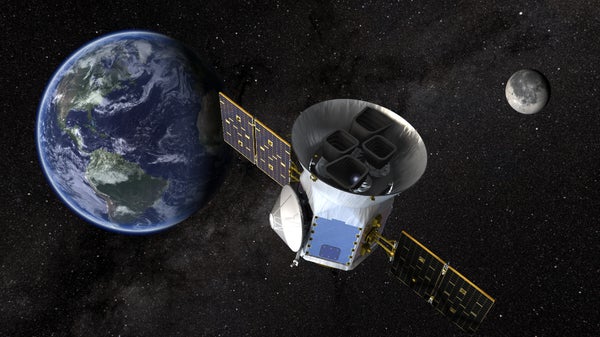
NASA's exoplanet-hunting
TESS space telescope is done with its primary mission, but its search for strange new worlds goes on.
TESS (short for "Transiting Exoplanet Survey Satellite") wrapped up its two-year primary mission on July 4, having discovered 66 confirmed
On supporting science journalism
If you're enjoying this article, consider supporting our award-winning journalism by subscribing. By purchasing a subscription you are helping to ensure the future of impactful stories about the discoveries and ideas shaping our world today.
alien planets and nearly 2,100 "candidates" that scientists still need to vet, NASA officials said.
TESS continues to study the heavens, however, on an extended mission that runs through September 2022.
"TESS is producing a torrent of high-quality observations providing valuable data across a wide range of science topics," Patricia Boyd, the project scientist for TESS at NASA's Goddard Space Flight Center in Greenbelt, Maryland,
said in a statement. "As it enters its extended mission, TESS is already a roaring success."
TESS launched to Earth orbit in April 2018 and began its science work three months later. The probe hunts for alien worlds using the "
transit method," monitoring stars for tiny brightness dips caused by orbiting worlds crossing their faces.
This same strategy was used to great effect by TESS' predecessor, NASA's pioneering
Kepler space telescope. Kepler, which was declared dead in October 2018, found about two-thirds of the 4,200 exoplanets discovered to date. (Kepler finds are still rolling in; scientists continue to pore over the spacecraft's huge data set, which has more than 3,000 additional candidates that require further analysis.)
TESS uses four cameras to study 24-by-96-degree sectors of the sky for about one month at a time. (Your clenched fist held at arm's length covers about 10 degrees of sky, for reference.) The probe spent the first year of its primary mission scrutinizing sectors in the southern sky, then switched to the northern sky in its second year.
The planet-hunting craft managed to cover about 75% of the sky during its two-year primary mission, NASA officials said.
The extended mission will feature the same order, with TESS focusing on the southern sky for the first 12 months before shifting to the northern sky. During that second year, the probe will also observe areas around the ecliptic, the plane of Earth's orbit around the sun.
TESS' primary mission yielded many exciting finds, including an Earth-sized planet called
TOI 700 d that orbits in its star's habitable zone, the range of distances where liquid water could be stable on a world's surface. But the extended mission may be even more fruitful, because the TESS team has made some improvements over the past two years.
The probe's "cameras now capture a full image every 10 minutes, three times faster than during the primary mission," NASA officials wrote in the same statement. "A new fast mode allows the brightness of thousands of stars to be measured every 20 seconds, along with the previous method of collecting these observations from tens of thousands of stars every two minutes."
The budget for TESS' primary mission was capped at $200 million, not including launch costs, which added another $87 million. The extended mission won't add too much to the overall price tag. For example, the extended-mission operations of NASA's New Horizons Pluto probe, which began in 2017, have cost
less than $15 million per year, on top of a prime-mission price tag of about $780 million.
Copyright 2020 Space.com, a Future company. All rights reserved. This material may not be published, broadcast, rewritten or redistributed.