
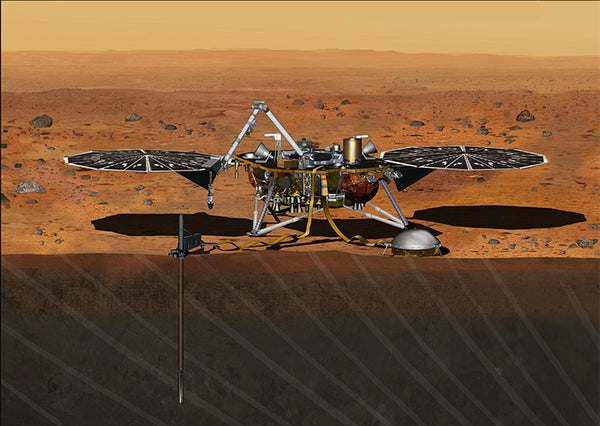
NASA will not launch its InSight spacecraft to Mars in March as originally planned, because of a leak in a French-built seismometer that is the spacecraft’s primary scientific instrument.
Technicians at CNES, the French space agency, have worked for months to repair a leak in a vacuum seal on the seismometer. OnDecember 22, NASA announced that it would suspend the launch. The delay means that InSight will not go off in 2016, but will have to wait 26 months until the Earth-Mars orbital geometry is once again favourable for launching a mission to the red planet.
InSight’s goal is to probe the structure of the Martian interior by listening to how marsquakes ring through the planet. The mission was designed to determine the size, composition and state of the planet's core, mantle and crust, which no previous Mars mission has done.
On supporting science journalism
If you're enjoying this article, consider supporting our award-winning journalism by subscribing. By purchasing a subscription you are helping to ensure the future of impactful stories about the discoveries and ideas shaping our world today.
“Trying to do something new, something truly exploratory is difficult,” says Lindy Elkins-Tanton, a planetary scientist at Arizona State University in Tempe. “The team is also contending with bringing together people in different countries who have not previously met, to build a new instrument.”
The spacecraft was to have launched from the Vandenberg launch site in California. Its builder, Lockheed Martin Space Systems of Denver, Colorado, shipped the probe to Vandenberg last week containing one of its two instruments, a German-built heat flow probe that would penetrate up to 5 meters into the Martian soil. The seismometer remained in France for testing. It was supposed to have arrived at Lockheed this spring for integration, says Tim Priser, InSight’s deputy program manager at Lockheed Martin.
NASA chose InSight over two other finalists in the Discovery class, a competition of planetary missions costing no more than $425 million: a boat that would have sailed on the lakes of Titan, and a probe that would have hopped repeatedly across the surface of a comet's nucleus.
InSight's delay may change scheduling of other NASA missions, says Elkins-Tanton, who leads one mission proposal, to the metallic asteroid Psyche, which is competing to be the Discovery mission to launch in the series after InSight. NASA had been considering choosing two of the five finalists in that round of competition, but the InSight delay is likely to require additional money that may chew into the Discovery program's budget. "Having an unscheduled hold will suck up money, but exactly what that means is all speculation at this point," says Barbara Cohen, a planetary scientist at NASA's Marshall Space Flight Center in Huntsville, Alabama.
Meanwhile, the European Space Agency is planning its own March launch to Mars, a Trace Gas Orbiter.
This article is reproduced with permission and was first published on December 22, 2015.