
In early 2017 two large passenger planes and a smaller corporate jet practiced landing, one right after the other, without the usual constant help of an air traffic controller. Instead they relied on NASA-developed technology that lets planes automatically “talk” to one another and to control towers, simultaneously. If these flight tests—which took place at an airport near Seattle—prove convincing, the technology could eventually make its way to the Federal Aviation Administration for approval. And if all planes one day adopt the system, more aircraft could land in less time at the country's increasingly congested airports.
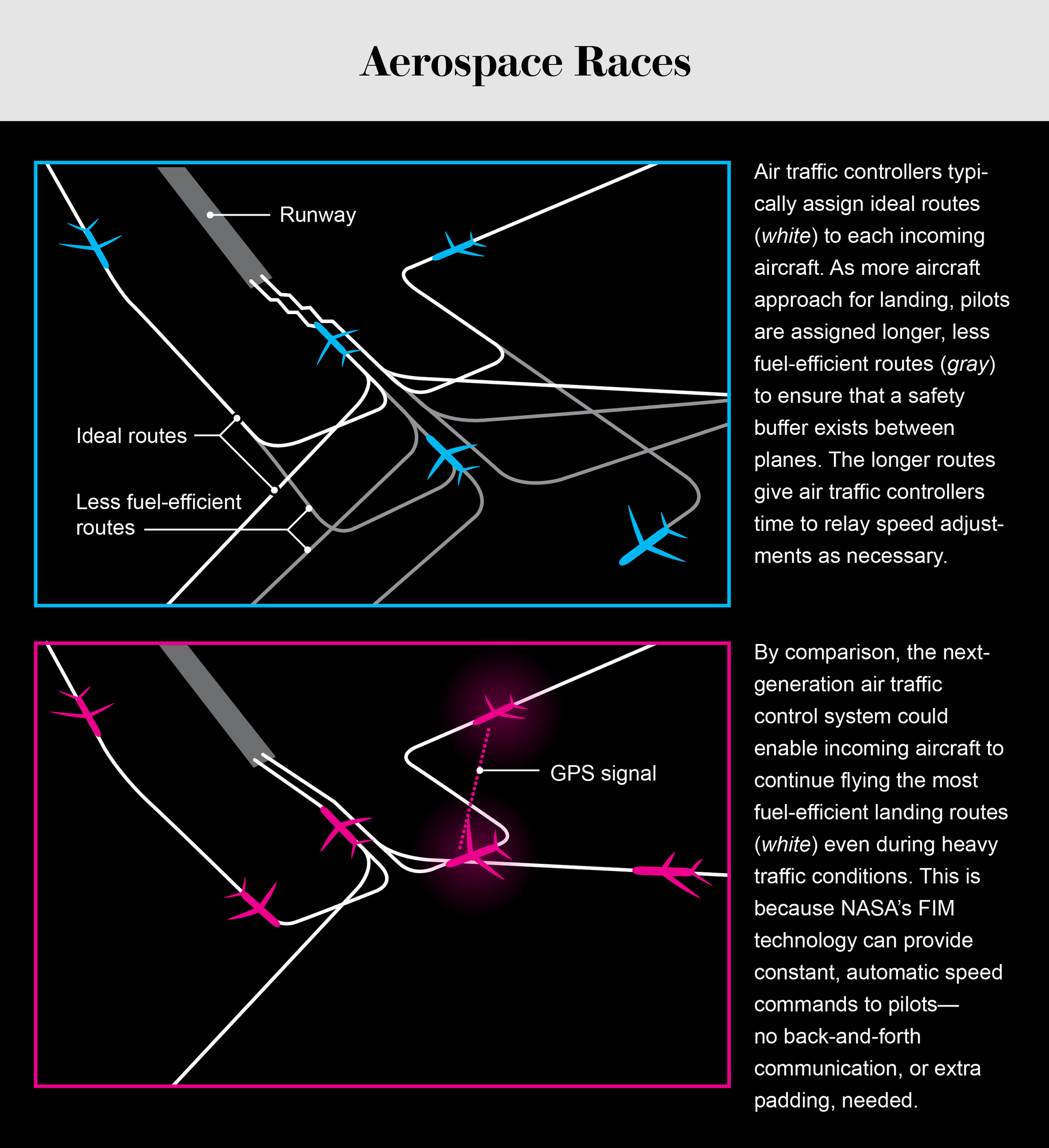
As planes line up for landing today, pilots maintain steady communication with air traffic controllers to ensure that all planes maintain safe distances from one another. The time spent relaying information means pilots can adjust speed only as quickly as they hear from the tower. This wait creates the need to leave an extra safety buffer of space between each arriving aircraft, limiting the number that can land within a given time.
NASA's flight deck interval management (FIM) system cuts down on the banter: it combines satellite-based location tracking and automated computer commands to keep track of planes' positions and constantly updates pilots on safe flight speeds for landing. This eliminates the padding between aircraft—which could save on fuel costs, reduce emissions and bump up the number of flights that arrive on time. “More aircraft landing per hour at airports means less delay for passengers,” says William Johnson, former project manager for Air Traffic Management Technology Demonstration-1 at the NASA Langley Research Center.
On supporting science journalism
If you're enjoying this article, consider supporting our award-winning journalism by subscribing. By purchasing a subscription you are helping to ensure the future of impactful stories about the discoveries and ideas shaping our world today.
How It Works
1 GPS signals determine each plane's location and ground speed. The plane automatically broadcasts this information to satellites and ground stations about once every second.
2 On the ground, a computer system uses the flight data to calculate the ideal spacing for each aircraft to maintain a fuel-efficient and continuous descent to the runway. Air traffic controllers pass that information to pilots via radio.
3 The pilots plug the spacing data into the FIM software installed in the plane's cockpit computer system. FIM also receives updates on the flight speeds of nearby aircraft, derived from GPS signals.
4 FIM processes all of that information and calculates the proper speed to maintain ideal spacing between planes preparing to land without compromising safety. That speed is displayed to the pilots in the cockpit and constantly updated until the landing gear touches the ground.
Credit: Amanda Montañez; Source: NASA Aviation Systems Division www.aviationsystemsdivision.arc.nasa.gov/research/tactical/atd1.shtml