
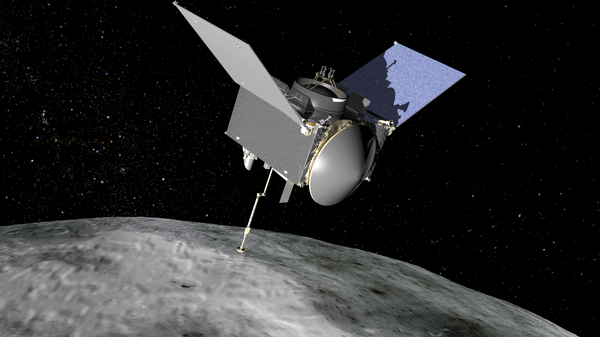
Liftoff for NASA's first-ever asteroid-sampling mission is just three weeks away.
The agency's OSIRIS-REx spacecraft is scheduled to launch atop a United Launch Alliance Atlas V rocket on Sept. 8 from Florida's Cape Canaveral Air Force Station. If all goes according to plan, the probe will return a pristine sample of the potentially hazardous space rock Bennu to Earth in September 2023.
"We seek samples that date back to the very dawn of our solar system," OSIRIS-REx principal investigator Dante Lauretta, a professor of planetary science and cosmochemistry at the University of Arizona's Lunar and Planetary Laboratory, said during a news conference today (Aug. 17). [OSIRIS-REx: NASA's Asteroid Sample-Return Mission in Pictures]
On supporting science journalism
If you're enjoying this article, consider supporting our award-winning journalism by subscribing. By purchasing a subscription you are helping to ensure the future of impactful stories about the discoveries and ideas shaping our world today.
"We want to get those back into our laboratories to understand the processes that may have led to the origin of life, and to the habitability of our planet," Lauretta added.
'The gift that keeps on giving'
OSIRIS-REx will take a circuitous path toward Bennu, finally meeting up with the 1,600-foot-wide (500 meters) space rock in August 2018.
The spacecraft will study Bennu from orbit for about two years. Then, in July 2020 or so, it will head down and grab at least 2 ounces (60 grams) of asteroid material.
"We don't technically land on Bennu, but we make contact with it for about 5 seconds," Jeff Grossman, OSIRIS-REx program scientist at NASA headquarters in Washington, D.C., said during today's news conference.
During these 5 seconds, the probe will blast the asteroid's surface with gas and collect the material that's blown out, Grossman explained.
Current plans call for OSIRIS-REx to leave Bennu for Earth in March 2021. In September 2023, the spacecraft will eject the sample capsule, which will land with the aid of parachutes in the Utah desert. (OSIRIS-REx, meanwhile, will be put in a stable "parking orbit" around the sun.)
The asteroid material will be studied for years to come by scientists around the world, much as the moon rocks returned by NASA's Apollo astronauts have been analyzed, Lauretta said.
"Sample return is the gift that keeps on giving," he said.
Though OSIRIS-REx is NASA's first asteroid-sampling mission, it isn't the first one in history: Japan's Hayabusa probe sent home tiny pieces of the space rock Itokawa in 2010. (And Hayabusa 2 launched in December 2014 to collect material from another asteroid, known as Ryugu.)
An ambitious mission
The OSIRIS-REx team is keen to hunt for organic molecules — the carbon-containing building blocks of life as we know it—in the material the spacecraft sends home.
But learning more about the solar system's early days and how life on Earth may have gotten its start isn't the only goal of the $800 million mission. Its full name—Origins-Spectral Interpretation-Resource Identification-Security-Regolith Explorer—makes that clear.
For example, OSIRIS-REx — which carries five scientific instruments — aims to learn more about the valuable resources that Bennu-like asteroids may possess, team members said.
The probe will also provide a detailed characterization of the Yarkovsky effect, which describes how small objects' paths through space are altered by the solar energy they radiate away as heat.
"When that happens, it acts like a thruster and changes the trajectory of the asteroid," Lauretta said. "If you want to be able to predict where an object like Bennu is going to be in the future, you have to account for this phenomenon, and we're going to provide the best-ever scientific investigation of this fascinating concept."
Such information is particularly relevant for potentially hazardous asteroids such as Bennu. There's a 0.037 percent chance that Bennu will hit Earth in the late 22nd century, NASA scientists say.
Asteroid Bennu Could Be A 22nd Century Problem For Earth | Video
Why Do Space Probes Have Spectrometers? OSIRIS-REx Instrument Explained | Video
Copyright 2016 SPACE.com, a Purch company. All rights reserved. This material may not be published, broadcast, rewritten or redistributed.