
NASA's next low-cost planetary missions will attempt to unravel the mysteries of some seriously bizarre asteroids.
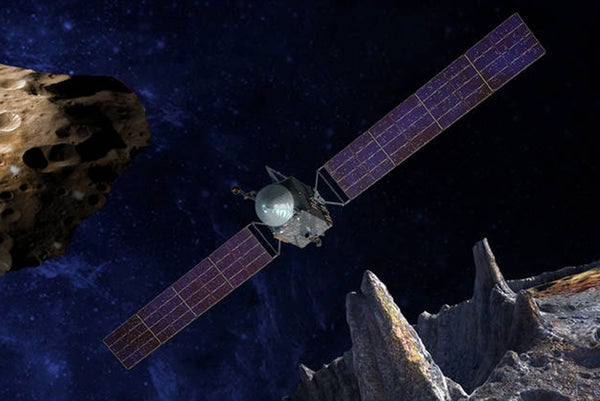
The space agency has selected projects called Lucy and Psyche via its Discovery Program, which funds highly focused space missions to destinations throughout the solar system. The Lucy project will investigate the Trojan asteroids, which share an orbit with Jupiter, while Psyche will journey to the asteroid belt to study a huge, metallic asteroid named 16 Psyche that resides there.
“This is what Discovery Program missions are all about — boldly going to places we've never been to enable groundbreaking science,” Thomas Zurbuchen, associate administrator for NASA's Science Mission Directorate in Washington, D.C., said in a statement today (Jan. 4). [NASA Mission to Metal Asteroid Psyche (Images)]
On supporting science journalism
If you're enjoying this article, consider supporting our award-winning journalism by subscribing. By purchasing a subscription you are helping to ensure the future of impactful stories about the discoveries and ideas shaping our world today.
Lucy is scheduled to launch in October 2021. If all goes according to plan, the probe will visit an asteroid in the main asteroid belt — located between Mars and Jupiter — in 2025, and then go on to study six Trojan asteroids between 2027 and 2033, NASA officials said.
There are two streams of Trojan asteroids. One trails Jupiter, and the other leads the giant planet around the sun. Scientists think both streams may be planetary building blocks that formed far from the sun before being captured into their current orbits by Jupiter's powerful gravity.
“This is a unique opportunity,” Lucy principal investigator Harold Levison, of the Southwest Research Institute in Boulder, Colorado, said in the same statement. “Because the Trojans are remnants of the primordial material that formed the outer planets, they hold vital clues to deciphering the history of the solar system. Lucy, like the human fossil for which it is named, will revolutionize the understanding of our origins.”
Psyche will explore one of the oddest objects in the solar system — a 130-mile-wide (210 kilometers) metallic asteroid that may be the core of an ancient, Mars-size planet. Violent collisions billions of years ago might have stripped away the layers of rock that once lay atop this metallic object, scientists say.
“This is an opportunity to explore a new type of world — not one of rock or ice, but of metal,” said Psyche principal investigator Lindy Elkins-Tanton, of Arizona State University.“ 16 Psyche is the only known object of its kind in the solar system, and this is the only way humans will ever visit a core. We learn about inner space by visiting outer space.”
Psyche is scheduled to launch in October 2023 and arrive at the asteroid in 2030, NASA officials said.
Lucy and Psyche were among five Discovery finalists that NASA announced last year. One of these other finalists, the dangerous-asteroid-hunting Near-Earth Object Camera (NEOCam), will get an additional year's worth of funding for continued development, NASA officials said.
The Discovery Program, which was founded in 1992, supports relatively low-cost planetary missions; development costs for the current crop are capped at about $450 million apiece, NASA officials said. The agency has funded 12 other Discovery missions in addition to those announced today, including the planet-hunting Kepler space telescope, the Dawn mission to the huge asteroids Vesta and Ceres, and the InSight Mars lander, which is due to launch next year.
Copyright 2016 SPACE.com, a Purch company. All rights reserved. This material may not be published, broadcast, rewritten or redistributed.