
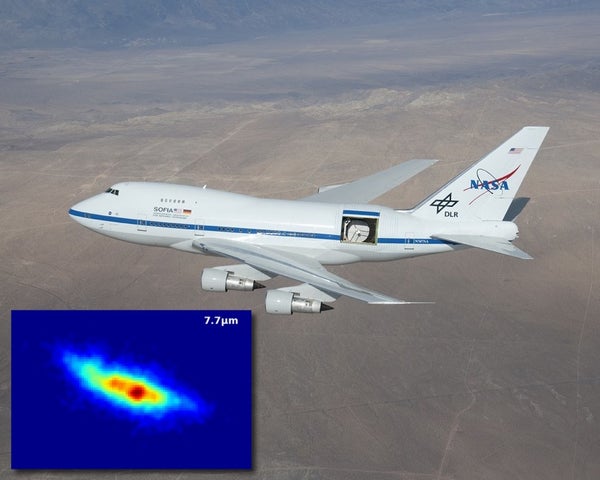
To look to the heavens, the SOFIA observatory takes to the skies.
Whereas telescope builders trying to give astronomers a clear look at the skies generally seek out arid mountaintops, where atmospheric distortion is minimal, a new telescope mounted on the side of a Boeing 747 does them one better. The 2.5-meter telescope built by NASA and the German Aerospace Center can climb as high as 13,700 meters to escape the atmosphere’s deleterious effects. Those altitudes allow the Stratospheric Observatory for Infrared Astronomy, or SOFIA, to rise above more than 99 percent of the atmosphere's distorting water vapor. As it traverses the skies, SOFIA stays fixed on a target with the help of stabilizing, fiber-optic gyroscopes.
The observatory first took flight in 2010, and now science from those early observing runs has entered peer-reviewed literature. The Astrophysical Journal Letters has published a special April 20 issue that includes eight studies presenting SOFIA's early science. Among them is a new look at Messier 82 (M82), a galaxy 12 million light-years away in the constellation Ursa Major.
On supporting science journalism
If you're enjoying this article, consider supporting our award-winning journalism by subscribing. By purchasing a subscription you are helping to ensure the future of impactful stories about the discoveries and ideas shaping our world today.
The photo inset above shows M82 as it looks at a wavelength of 7.7 microns, in the mid-infrared. (A micron is one millionth of a meter.) M82 is a bright object in the infrared—it is currently undergoing a burst of star formation, initiated a few tens of millions of years ago by an encounter with a nearby galaxy. The star-forming cluster at the center of the galaxy appears to be ringed by gas, the position of which aligns roughly with the central bright spot in the image and with the secondary bright spot just to the left.