NASA's new rocket ready for test launch despite iffy future

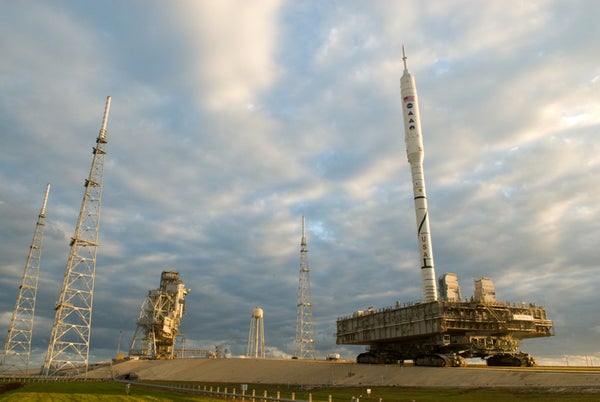
The 100-meter-tall Ares 1-X rocket was rolled out to the launch pad Tuesday morning at NASA's Kennedy Space Center in Florida.

NASA/Kim Shiflett

Join Our Community of Science Lovers!


On supporting science journalism

If you're enjoying this article, consider supporting our award-winning journalism by subscribing. By purchasing a subscription you are helping to ensure the future of impactful stories about the discoveries and ideas shaping our world today.


The 100-meter-tall Ares 1-X rocket was rolled out to the launch pad Tuesday morning at NASA's Kennedy Space Center in Florida. The rocket, targeted to launch October 27, is a test vehicle for Ares 1, which would carry astronauts to orbit via the Constellation program, the next-generation spaceflight system designed to replace the space shuttle and expected to come online around 2015.

But the future of Constellation, and of Ares 1 specifically, is hardly secure. An independent panel convened by the Obama administration to review NASA's plans for human spaceflight is expected to deliver its full assessment Thursday, but a summary version released in September deemed NASA to be "on an unsustainable trajectory." The Review of U.S. Human Space Flight Plans Committee estimated that Constellation won't send astronauts into orbit before 2017, two years later than is commonly projected.

What is more, the International Space Station, only now nearing completion, is at risk of being deorbited in 2016 on NASA's current budget. If the space agency chose to keep the station flying until 2020 without a budget boost from Congress, one way to recoup the cost, the committee noted, would be to scrap Ares 1 altogether and rely on commercial firms to launch astronauts into orbit.

It’s Time to Stand Up for Science

If you enjoyed this article, I’d like to ask for your support. Scientific American has served as an advocate for science and industry for 180 years, and right now may be the most critical moment in that two-century history.

I’ve been a Scientific American subscriber since I was 12 years old, and it helped shape the way I look at the world. SciAm always educates and delights me, and inspires a sense of awe for our vast, beautiful universe. I hope it does that for you, too.

If you subscribe to Scientific American, you help ensure that our coverage is centered on meaningful research and discovery; that we have the resources to report on the decisions that threaten labs across the U.S.; and that we support both budding and working scientists at a time when the value of science itself too often goes unrecognized.

In return, you get essential news, captivating podcasts, brilliant infographics, can't-miss newsletters, must-watch videos, challenging games, and the science world's best writing and reporting. You can even gift someone a subscription.

There has never been a more important time for us to stand up and show why science matters. I hope you’ll support us in that mission.

Thank you,

David M. Ewalt, Editor in Chief, Scientific American

Subscribe