
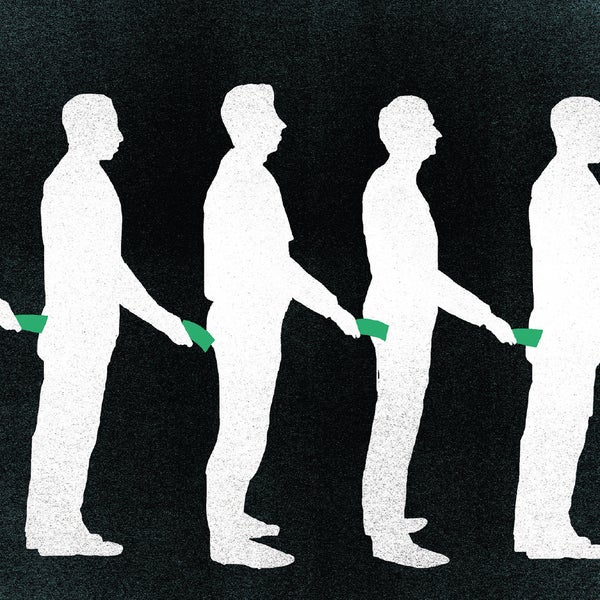
One bad apple spoils the barrel, so the saying goes. But what if the barrel itself is rotten?
A number of studies have shown that seeing a peer behave unethically increases people's dishonesty in laboratory tests. What is much harder to investigate is how this kind of influence operates at a societal level. But that is exactly what behavioral economists Simon Gächter of the University of Nottingham in England and Jonathan Schulz of Yale University set out to do in a study published in March 2016 in Nature. Their findings suggest that corruption not only harms a nation's prosperity but also shapes the moral behavior of its citizens. The results have implications for interventions aimed at tackling corruption.
The researchers developed a measure of corruption by combining three widely used metrics that capture levels of political fraud, tax evasion and corruption in a given country. “We wanted to get a really broad index, including many different aspects of rule violations,” Schulz says. They then conducted an experiment involving 2,568 participants from 23 nations. Participants were asked to roll a die twice and report the outcome of only the first roll. They received a sum of money proportional to the number reported but got nothing for rolling a six. Nobody else saw the die, so participants were free to lie about the outcome.
On supporting science journalism
If you're enjoying this article, consider supporting our award-winning journalism by subscribing. By purchasing a subscription you are helping to ensure the future of impactful stories about the discoveries and ideas shaping our world today.
If everyone were completely honest about their die rolls, the average claim would be 2.5, whereas if everyone were maximally dishonest, all claims would be 5. Participants from nations with a high prevalence of rule violations (PRV)—including Georgia, Tanzania, Guatemala and Kenya—tended to claim more than those from low-PRV countries—such as Austria, the U.K., the Netherlands, Sweden and Germany—and average claims correlated with PRV values. In other words, the more corrupt the country, the more its citizens inflated the number they reported. These values were calculated using data from 2003, and the experiments were conducted between 2011 and 2014 using participants whose average age was 21—too young to have personally influenced PRV ratings but old enough to have been influenced by social norms, implying that national corruption levels influenced participants' honesty, not vice versa.
“These researchers link a simple cheating test to real-world behaviors,” says behavioral scientist Amos Schurr of Ben-Gurion University of the Negev in Israel, who was not involved in the study. “This has never been done before.”
Encouragingly, the researchers found that there was a limit to people's dishonesty, even if they came from profoundly corrupt countries. Claims clustered around the number expected mathematically if, instead of outright lying, people shuffled the facts to report the highest roll instead of the first. “All around the world people are quite honest,” Schulz says. They tend to act according to “justifiable dishonesty,” but the benchmark of what is justifiable seems to vary slightly according to the level of corruption in one's homeland.
Classic economic theory assumes that people act to maximize their gains, but the finding that they do not lie outright fits with theories suggesting individuals have a psychological incentive to view themselves as honest. “You have competing forces: financial incentives and psychological incentives to keep an honest self-view, which balance out,” Schulz explains. “It's easier to keep a good self-image while being more corrupt if you see a lot of corruption around you.”
The findings imply that highly corrupt countries may be difficult to change because their citizens have been shaped by norms that permit dishonesty. Yet there is also a positive practical implication. Rather than tackling corruption by targeting institutions, we might do better to aim at young people. “Changing formal institutions will be hard, but institutions rely on people,” Schulz says. “It will take a long time, but I think it's a worthwhile path.”