
National security experts urged the elimination of all greenhouse gas emissions in a report yesterday that warns of international catastrophe if the global temperatures continue to rise on their current trajectory.
The report by the Center for Climate and Security, an independent think tank, describes familiar scenarios of escalating conflict as climate change diminishes food and water supplies, displacing millions of people.
But the report, written by a team of experts and former U.S. diplomats and military leaders, takes the bold step of saying that mitigating the risks of climate change “requires quickly reducing and phasing out global greenhouse gas emissions.”
On supporting science journalism
If you're enjoying this article, consider supporting our award-winning journalism by subscribing. By purchasing a subscription you are helping to ensure the future of impactful stories about the discoveries and ideas shaping our world today.
“We call for the world to achieve net-zero global emissions as soon as possible in a manner that is ambitious, safe, equitable and well-governed in order to avoid severe and catastrophic security futures,” the report states without recommending pathways to its goal.
Emissions reductions that nations pledged in the Paris climate agreement of 2015 “are not nearly commensurate to contain the threat," the report says, noting that global temperatures would rise roughly 2.5 degrees Celsius above preindustrial levels by 2100.
The report also urges “climate-proofing” the world’s infrastructure and institutions to build resilience to climate change that is currently underway.
“We need to start taking these threats much more seriously than we are,” Kate Guy, a lead report author, said in a briefing yesterday. “Even at low, near-term levels of warming, the threats and the impacts are very, very severe. No region of the world is unimpacted, even at low levels of warming.”
The report describes the likely effects of two climate scenarios. The first involves global average temperatures rising by 1 to 2 C above preindustrial levels by 2050. The second scenario involves global average temperatures rising 2 to 4 C by 2100.
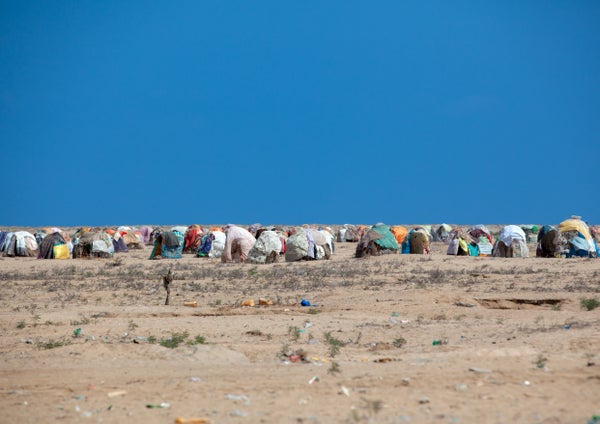
The main global effect of the latter scenario is the displacement of people from parts of Africa, the Middle East and Central Asia that become uninhabitable due to extraordinary heat and competition over limited water resources. An influx of migrants to Europe and Russia would cause “a breakdown in regional political, institutional, and security cohesion,” the report says.
“We’re going to have unlivable spaces where people already live,” said John Conger, director of the Center for Climate and Security and a former Defense Department comptroller. “As people run out of water, as people have food insecurity, as people experience temperatures where you cannot be outside without air conditioning, there will be new unlivable spaces, and you’ll have to move somewhere else.”
In North America, extreme global warming will cause more extreme storms and wildfires and could generate “increasing divisions within society—including rising ethnonationalist, anti-democratic and isolationist views,” the report says.
The nonpartisan Center for Climate and Security was founded in 2010 by two climate researchers. Its advisory board includes former U.S. officials, diplomats and senior military officers, among them retired Marine Corps Gen. Anthony Zinni, a former commander of the Middle East-based U.S. Central Command whom the Trump administration tapped in 2017 to mediate a dispute among Persian Gulf nations.
One study author, Richard Kauzlarich, said at yesterday’s briefing that he worries about the consequences of phasing out greenhouse gas emissions.
“One billion people don’t have electricity. How do these people achieve their goal of just having electricity?” said Kauzlarich, a retired veteran diplomat and senior intelligence officer under President George W. Bush.
Oil-producing countries such as Azerbaijan, Angola and Mozambique will have “no way of achieving the growth that we thought was so important for their development,” he said.
“There are a whole lot of changes that are going to intensify security threats because we do begin to act,” Kauzlarich said.
Reprinted from Climatewire with permission from E&E News. E&E provides daily coverage of essential energy and environmental news at www.eenews.net.