
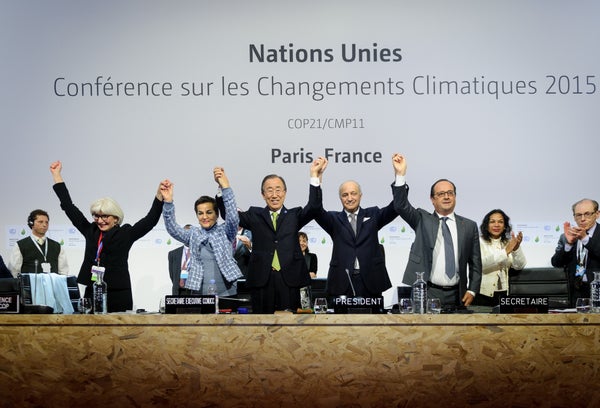
Nearly 200 nations are meeting today in Marrakech, Morocco, for the United Nations annual climate conference. The two-week 22nd Conference of the Parties, or COP 22, starts just days after the 2015 Paris climate accord entered into legal force—meaning that countries are legally bound to meet their targets—on November 4. And although many are celebrating this latest success, country representatives at COP 22 now must hash out how they are going to live up to their pledges—namely, curbing CO2 emissions so that the world can avoid climate change’s worst effects.
Many people expected it would take years, possibly decades, to ratify the Paris accord. Instead, it took only months before enough countries—55 nations representing 55 percent of global emissions—had joined the agreement so that it could take effect. As of today, 100 countries that produce 69 percent of worldwide emissions have ratified it. In doing so they have promised to do their part to limit emissions so that global temperatures do not rise more than 2 degrees Celsius above preindustrial levels. The agreement also encourages nations to try to go further and limit a global temperature increase to 1.5 degrees C.
The accord was a big deal because nations promised to reduce their greenhouse gas emissions by specific amounts. The U.S., for instance, pledged to cut its emissions 26 to 28 percent below 2005 levels by 2025. Now at COP 22, nations will focus on how to implement the agreement. They are set to figure out how to make sure nations meet their pledges, which means devising ways to track and report countries’ emissions, and check on their progress. Negotiators will also discuss how to do the five-year reviews of everyone’s climate action plans, during which countries will regularly assess whether they are meetingor should raise their pledged emissions cuts. Developed nations also must sort out the details of providing financial support to developing countries. The latter have been promised $100 billion per year in funding, but it is unclear whether wealthy nations have committed enough yet to reach that number. Representatives still need to work out issues such as what exactly counts as climate finance and how to use the funds.
On supporting science journalism
If you're enjoying this article, consider supporting our award-winning journalism by subscribing. By purchasing a subscription you are helping to ensure the future of impactful stories about the discoveries and ideas shaping our world today.
“This is the ‘year of action’ and the years ahead are the years of implementation,” explains Paula Caballero, global director of the World Resources Institute’s Climate Program. “By 2018, we need to see clarification on the rules and processes for implementing the historic agreement we set out in Paris last year.” Although that means we probably will not have the sort of exciting grand finale we saw in Paris last year, COP 22 is still critical to solving our climate challenge.
This year’s U.N. summit comes after a year of intense progress on combating climate change.In October more than 170 countries reached a deal to phase out their use of potent greenhouse gases known as hydrofluorocarbons. The aviation industry also recently agreed to limit or offset its carbon emissions. But even so, the world is not on track to meet its climate goal. A U.N. report released just last week found that if every country met its Paris emissions pledge, global temperatures would still rise above the 2 degree C cutoff. COP 22 is necessary to initiate important work toward meeting that limit, but for the world there still is a lot of work to do.
*Editor's Note (11/07/16): This sentence was updated after posting to reflect the latest number of countries to ratify the Paris agreement.