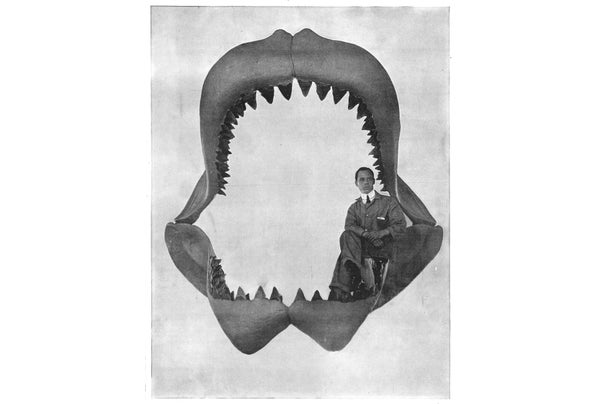
Restoration of “monster” Carcharodon megalodon fossil at the American Museum of Natural History, New York. The jaws are currently on display in the Hall of Vertebrate Origins.
Image: Scientific American, July 29, 1916
Join Our Community of Science Lovers!
On supporting science journalism
If you're enjoying this article, consider supporting our award-winning journalism by subscribing. By purchasing a subscription you are helping to ensure the future of impactful stories about the discoveries and ideas shaping our world today.
The April 2016 issue of Scientific American peers into the distant past of natural organisms (including the human one) with the help of electron microscopes, computer modeling, DNA comparisons of living species and even magnetic resonance images of brains of modern researchers as they learn the ancient art of flint knapping. A century ago in 1916 the science of natural history was just learning how to use tools such as the camera, glass models, artists’ reconstructions, and studying whatever living or dead specimens they could find. In this slide show are some images from the frontiers of the science of natural history from 100 years ago.
You can find much more on the history of natural history by excavating articles from the Scientific American Archive at scientificamerican.com/magazine/sa
It’s Time to Stand Up for Science
If you enjoyed this article, I’d like to ask for your support. Scientific American has served as an advocate for science and industry for 180 years, and right now may be the most critical moment in that two-century history.
SciAm always educates and delights me, and inspires a sense of awe for our vast, beautiful universe. I hope it does that for you, too.
If you subscribe to Scientific American, you help ensure that our coverage is centered on meaningful research and discovery; that we have the resources to report on the decisions that threaten labs across the U.S.; and that we support both budding and working scientists at a time when the value of science itself too often goes unrecognized.