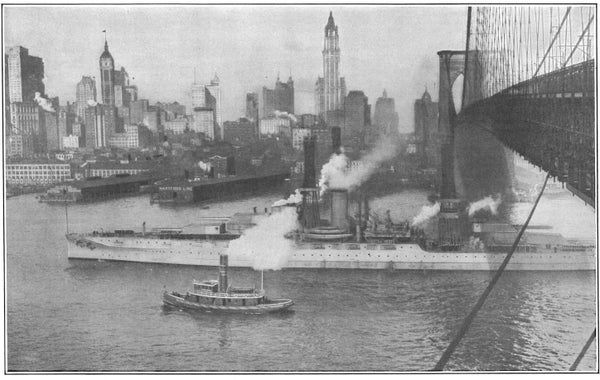
U.S.S. Arizona: This “superdreadnought” battleship (shown leaving the Brooklyn Navy Yard after being commissioned in 1916) was the U.S. Navy’s largest and most modern warship. The ship served in American waters in World War 1, and was sunk in Pearl Harbor at the beginning of World War 2.
Image: Scientific American, November 25, 1916
Join Our Community of Science Lovers!
On supporting science journalism
If you're enjoying this article, consider supporting our award-winning journalism by subscribing. By purchasing a subscription you are helping to ensure the future of impactful stories about the discoveries and ideas shaping our world today.
The year 1916 opened with no prospect of victory for any of the participants in the Great War—or even the sign of an ending—despite millions of casualties on all sides. The belligerents had co-opted large segments of industrial and scientific capacity and shifted significant portions of their populations away from peacetime industries into military service. Those in charge desperately sought to find some way of gaining an advantage, of any kind, over their opponents. One possible road to victory lay through the invention or adoption of some kind of technology to gain even a small measure of dominance, if not in the trenches in northern France and Belgium, then in the open oceans that were so vital to the trade that supplied the vast appetite of wartime production. These slides from Scientific American issues in 1916 give us a snapshot of that struggle.
You can purchase a cruise through the coverage of the First World War or all 171 years of the Archive at scientificamerican.com/magazine/sa
Subscribe to Support Independent Journalism
Great science journalism requires human expertise, time, effort and creativity. And it costs money. That’s why I and the journalists here at Scientific American hope you’ll join our community.
When you subscribe, you are supporting staff and freelance journalists who are passionate about telling science stories that are true, important and compelling. Our editors and reporters are often experts in their fields, which means they understand the nuances of big discoveries and can untangle the breakthroughs from the hype. With a subscription, you are also supporting rigorous fact-checking to ensure the words we publish are precise and accurate. And you’re supporting original illustrations, graphics and photos that bring you closer to an advanced laboratory, an ice sheet in Antarctica or a space mission in orbit. You’re helping us craft other types of high-quality journalism as well: Our newsletters are carefully written, edited and curated by staffers you have or will come to know and love. Our Science Quickly podcast is based on original reporting, collaboration with editors and scientists and exacting production.
Subscriptions keep this engine running so we can continue to deliver thoughtful, rigorous and independent science journalism to you. In an era of viral misinformation, this work is crucial. If you value what we do, I hope you’ll consider joining us as a subscriber
Thank you,
Jeanna Bryner, Editor in Chief, Scientific American