
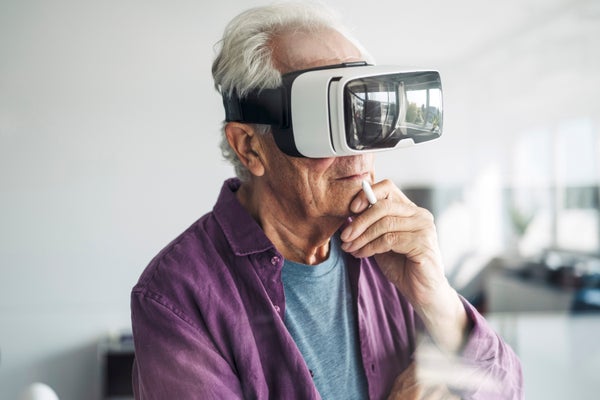
Scientists have long sought to prevent sharp memories from dulling with age, but the problem remains stubborn. Now research published in Scientific Reports suggests virtual reality might help older people recall facts and events based on specific details.
The study involved 42 healthy older adults from the San Francisco Bay Area. Half spent a dozen hours over four weeks playing a virtual-reality game called Labyrinth; they strapped on headsets and walked in place, roaming virtual neighborhoods while completing errands. The other half, in the control group, used electronic tablets to play games that did not require navigating or recalling details. After 15 sessions, the latter performed roughly the same as before on a long-term memory test based on picking out objects they had seen about an hour earlier. But the Labyrinth players' scores rose, and they were less frequently tricked by objects that resembled ones they had viewed.
Those improvements “brought them back up to the level of another group of younger adults who did the same memory tests,” says cognitive neuroscientist Peter Wais of the University of California, San Francisco. He and his colleagues designed the VR game, which they say likely stimulates the hippocampus—a brain area important for long-term memory. The team did not observe improvement on two other tests, which measured autobiographical memory and spatial memory capability.
On supporting science journalism
If you're enjoying this article, consider supporting our award-winning journalism by subscribing. By purchasing a subscription you are helping to ensure the future of impactful stories about the discoveries and ideas shaping our world today.
“What they're trying to do is uniquely suited to VR,” says Meredith Thompson, a Massachusetts Institute of Technology education researcher, who studies learning through VR games but was not involved in the new study. VR can provide greater immersion and engagement than other games, she says, adding that after this proof-of-concept study, “it would be great to actually follow people over time and see what this type of game does for long-term memory.” Wais's team is now investigating how long the observed effects last and which elements of the training have the most impact.
“It's great that they measured expectations for improvement for the intervention and placebo conditions,” says Daniel Simons, a University of Illinois at Urbana-Champaign cognitive psychologist, who was also not involved in the study. Experiments with other games that claim to train the brain have often failed to evaluate this, he notes. But Simons adds that testing three measures, instead of just one, increased the likelihood of finding an improvement. And it remains unclear how test performance in a laboratory setting might translate to real-world situations. The outcome, Simons notes, “needs to be repeated, ideally with a much larger group, before it's treated as a strong finding.”
For now, Wais says, the team hopes its studies with similar-sized groups will help draw funding to test the game in a larger pool of participants.