
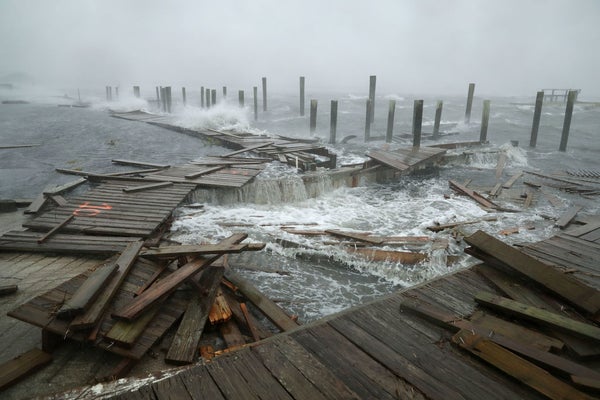
While Hurricane Florence was still barreling toward the East Coast, the Navy shipped its vessels out of harm’s way.
But the sailors had another problem: What would happen to their cars parked back at base if Florence hit coastal Virginia?
While Florence largely steered clear of the cars parked at the naval base in Hampton Roads, Va., the episode was emblematic of the type of cascading problems that planners will increasingly have to take into account. That type of trickle-down issue illustrates the gaps in planning for climate change, Ann Phillips, a retired Navy rear admiral, said yesterday at a panel on how climate change will challenge military and civilian infrastructure.
On supporting science journalism
If you're enjoying this article, consider supporting our award-winning journalism by subscribing. By purchasing a subscription you are helping to ensure the future of impactful stories about the discoveries and ideas shaping our world today.
“In the Navy, we don’t value or fund infrastructure,” said Phillips, a board member of the Center for Climate and Security think tank, which hosted the panel to highlight the second edition of its report on the most vulnerable military sites. “We like stuff. We don’t like infrastructure.”
The military might be even less prepared than some coastal cities, panelists said. The same officials might run a city for a few years, giving them time to notice the effects of climate change and get adaptation programs running. But most regions get a new commander every two years or so.
That’s been the case in Hampton Roads, the southeastern region of Virginia that hosts a large Navy base along with several other military sites.
A commander who prioritized climate change policies was followed by one who did not, Phillips said.
“An excellent officer, a fine gentleman, has never been to Hampton Roads before, can’t spell sea-level rise,” she said. “[That] doesn’t stop anything that’s going on, but it’s just not their No. 1 priority.”
The military has been working on climate risks for years. Phillips pointed to a software project with NASA, now part of the larger Adapt Virginia portal, that she said is helping reduce flood damages from hundreds of millions of dollars to hundreds of thousands.
Such work is expected to continue, in part due to a provision in the military spending bill that allows the Department of Defense to fund adaptation projects outside the fence line of bases, said David Titley, a retired Navy rear admiral who now teaches at Pennsylvania State University.
“There’s lip service, and then there’s doing, sorta, some things—actually more than you would expect—more than you would expect from the White House tweets, I’ll put it that way,” he said.
Florence offered coastal communities a preview of their long-term flood risk from sea-level rise. But in the short term, experts said, it’s unrealistic to assume people will change their behavior based on one storm.
Susan Cohen, a Navy biologist, said a real estate agent she knows in the vulnerable area of Topsail Beach, N.C., closed on a house the same day that Florence was making landfall.
“We make these crazy decisions, but we live in paradise [and] we don’t want to leave,” she said. “And then we have storms like this, and we’re all going to cash our federal insurance checks.”
Study quantifies sea-level-rise damages from Florence
Meanwhile, the First Street Foundation, a nonprofit research organization, yesterday released an analysis showing that sea-level rise off the Carolina coast contributed to storm surge flooding of 11,000 more homes than would have been inundated under similar storm conditions in 1970.
The finding is based on geospatial analysis of Florence’s storm surge across the Carolina coast in 2018 compared with 1970, when average sea levels were 6 inches lower than today.
Overall, the scientists found that Florence’s storm surge affected more than 51,000 homes and buildings by pushing seawater over at least 25 percent of each property. But that number would have been only 40,000 properties under sea-level conditions 48 years ago, and possibly as few as 23,000 properties when factoring for the growth in residential and commercial development since 1970.
“Even though the impact of Hurricane Florence continues to be felt, we already know that sea-level rise has made the damage significantly worse, as observed with other recent storms,” said Steven McAlpine, First Street’s head of data science.
The analysis further found that under an Army Corps of Engineers-projected 15 inches of sea-level rise by 2050, Florence’s storm surge would have been nearly twice as destructive, damaging an estimated 102,000 homes and businesses.
“With sea levels and coastal development on the rise, the impacts of hurricane storm surge will only get worse,” said the group’s executive director, Matthew Eby. “The time to rethink America’s sea-level rise and adaptation strategy is now.”
Reprinted from Climatewire with permission from E&E News. E&E provides daily coverage of essential energy and environmental news at www.eenews.net.