
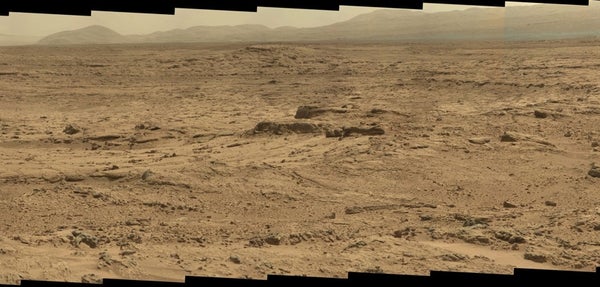
NASA's Mars rover Curiosity is comfortably ensconced at Rocknest, a patch of sand where the robot has been testing out some of its sample-analysis instruments for the first time. But in the not-too-distant future the rover will be on the move again to more fully explore a region known as Glenelg, which looks to feature a conjunction of multiple terrain types.
Mission planners snapped the photos in the mosaic above, looking out into Glenelg, to help chart a route for exploration. "Those images will help guide us and give the team options in terms of what I'm starting to call 'tours,'" Curiosity project scientist John Grotzinger of the California Institute of Technology said in an October 18 teleconference. Grotzinger added that such imagery will also help mission scientists select the first rock that the rover will sample using the drill on its robotic arm.
Photographer, writer and chemist Ken Kremer, and photographer and educator Marco Di Lorenzo stitched together the composite photo from dozens of images captured with Curiosity's telephoto camera, the Mastcam 100, while the rover was parked at Rocknest. The segment above, comprising about 27 images, is a detail of a larger mosaic assembled from 75 of the Mastcam 100 photographs.
On supporting science journalism
If you're enjoying this article, consider supporting our award-winning journalism by subscribing. By purchasing a subscription you are helping to ensure the future of impactful stories about the discoveries and ideas shaping our world today.
—John Matson