
From atop California's Sierra Nevada Mountains, it is a downhill trek into Nevada. But back in the Oligocene, you would have had a climb ahead of you. During that epoch and the latter part of the Eocene before it, the West Coast was host to a broad band of mountains resembling the modern South American Andes. Over time, the earth's crust in this region, known as the Basin and Range Province, stretched until it cracked into blocks, tilting like thick volumes between sliding bookends. Geologists are now mapping that long-ago transformation by using a phenomenon that has spanned geologic time: rain.
Twenty-three million to 40 million years ago a series of volcanic eruptions in eastern Nevada produced rolling clouds of hot ash and cinders that coursed downhill all the way to the Pacific Ocean, leaving a trail behind them. For the following few millennia, rain diffused into these porous volcanic deposits—a mix of ash and rock particles—leaving behind clues about the ground's altitude.
Those clues come in the form of hydrogen isotopes: rainwater molecules with heavier hydrogen atoms, which leave clouds at lower altitudes, become scarcer as rain clouds move to higher ground. Following that logic, University of Idaho geologist Elizabeth Cassel and her colleagues measured the isotope ratios in rock samples between the Sierra Nevada and eastern Nevada to map the mountain scapes of yesteryear (below). Their results were published in November in the journal Geology.
On supporting science journalism
If you're enjoying this article, consider supporting our award-winning journalism by subscribing. By purchasing a subscription you are helping to ensure the future of impactful stories about the discoveries and ideas shaping our world today.
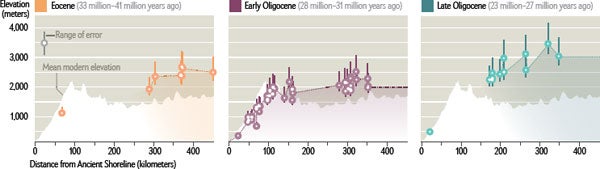
Credit: Graphic By Tiffany Farrant-Gonzalez; Source:PROFILE OF A PALEO-OROGEN: HIGH TOPOGRAPHY ACROSS THE PRESENT-DAY BASIN AND RANGE FROM 40 TO 23 MA," BY ELIZABETH J. CASSEL ET AL., IN GEOLOGY VOL. 42 NO. 11; NOVEMBER 2014
Experts had thought that the state was a plateau 25 million years ago, rising no higher than the Sierra Nevada, but the rainwater isotopes reveal that the peak elevation in eastern Nevada rose more than 1,200 meters above the Sierra Nevada—roughly 2,100 meters higher than it sits today.
Rock samples of different ages testify that Nevada's mountains stood tall for more than 20 million years, ruling out fleeting geologic activity as the source of the area's drastic transformation. Instead the continental crust must have thickened there, squeezed by the colliding North American and Pacific plates. When that collision ceased (eventually birthing the San Andreas Fault), the compressed crust spread out between its loosened bookends—yielding the more expansive view today.