
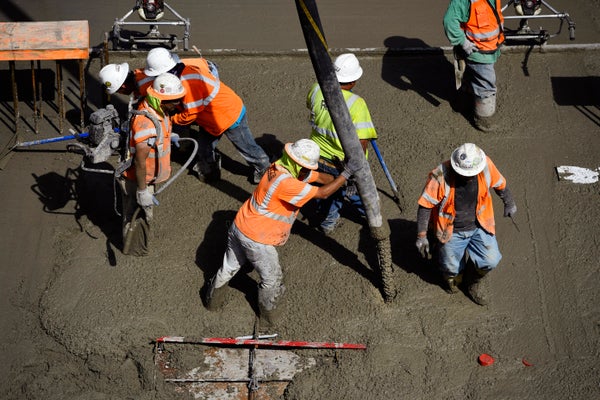
Daily temperature swings can make water freeze and expand, then thaw and contract. Because concrete is porous and absorbs liquid, these changes often make its surface flake and peel. But researchers say a new process can help prevent such deterioration.
“The primary way in which we have resisted this freeze-thaw damage in the past was by using a technology that was developed in the 1930s, which was to put in tiny little air bubbles all throughout the concrete,” says Wil Srubar, a materials scientist and architectural engineer at the University of Colorado Boulder. These flexible bubbles absorb some pressure but also reduce concrete's strength, make it soak up more water and require a finicky distribution process.
Srubar's laboratory looked to the natural world, specifically “antifreeze” proteins that let some fish and bacteria endure frigid temperatures. In cells, these molecules cling to ice crystals' surfaces and prevent them from growing too large—but they do not function in highly alkaline cement paste, a key concrete ingredient. So the researchers tried a tougher substance with similar properties: a polymer called PEG-PVA, which is currently used in time-released pharmaceutical pills.
On supporting science journalism
If you're enjoying this article, consider supporting our award-winning journalism by subscribing. By purchasing a subscription you are helping to ensure the future of impactful stories about the discoveries and ideas shaping our world today.
To test it, the team mixed several batches of concrete, including one control, one with air bubbles and a few with different concentrations of the PEG-PVA additive. After 300 consecutive freeze-thaw cycles, the quality of the control sample plummeted while others maintained their integrity. The research was published in June in Cell Reports Physical Science.
Vikki Edmondson, a civil engineer at Northumbria University in England, who was not involved in the study, says the new work is important but will need investigation beyond the lab. “For instance, if we look at the design life of a bridge,” she says, “how is this going to help protect critical infrastructure?” Edmondson wonders how this additive would function in the real world, where concrete must withstand vibrations, for instance, and endure exposure to contaminants.
“Anything that makes cement more durable ... is obviously progress,” says Roland Pellenq, a director of research at the French National Center for Scientific Research, who was also not involved in the new study. Because freeze-thaw damage presents such a threat to infrastructure, other researchers are also exploring solutions—Pellenq says his own team has experimented with a water-repelling black carbon additive for this purpose.
Srubar has filed a provisional patent and hopes to bring the PEG-PVA process to market within five years. Meanwhile he continues the hunt for molecules that mimic antifreeze proteins' behavior. “Everybody in my lab is convinced that nature has solved all of our problems for us,” he says. “We just have to know where to look.”