
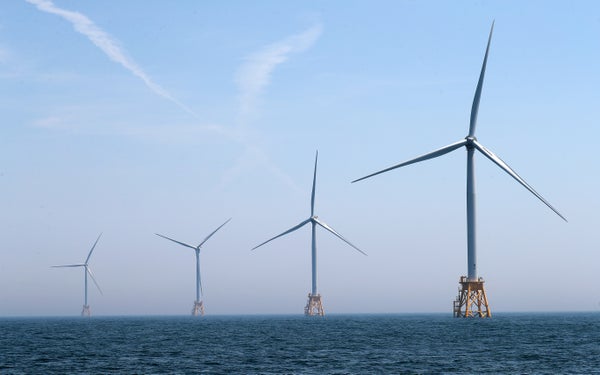
The Nature Conservancy has released a new mapping tool designed to show the potential impact that thousands of offshore wind turbines along the East Coast could have on whales and other marine life.
The tool, the first of its kind for the coastal area between Maine and North Carolina, was created to support the use of offshore wind power, but also to “protect the places that fish and whales congregate.”
Officials at the conservancy, which has over 1 million members including 400 staff scientists, acknowledged during a virtual press conference that there are still “gaps” in understanding how wind turbines may change fish behavior.
On supporting science journalism
If you're enjoying this article, consider supporting our award-winning journalism by subscribing. By purchasing a subscription you are helping to ensure the future of impactful stories about the discoveries and ideas shaping our world today.
Another unknown, according to Chris McGuire, director of the group's marine program in Massachusetts — where the first big U.S. offshore site is underway — is how future changes to the ocean, including warming water, will affect the behavior of fish.
“Separately there is a project for funding today that is trying to get at the climate prediction side of this,” he explained in an interview. But he added that it will take several years to fill in that gap. Conservancy scientists are working with experts at Rutgers University to study the issue.
It currently takes as long as 10 years for states and the federal government to approve offshore areas for wind leasing, McGuire noted. The mapping tool would offer computerized data about where species of fish congregate at various times of the year.
It comes as President Biden aims to develop 30 gigawatts of offshore wind capacity by 2030. That would amount to about 2,000 turbines along the East Coast.
Tensions are already high in Massachusetts, where commercial fishing groups have criticized Vineyard Wind for threatening their business.
Although the conservancy supports offshore renewable energy, it hopes the maps can be used by both sides to resolve conflicts between wind developers and the fishing industry.
Some fish species have been attracted to formations of boulders that help anchor turbines to the sea floor. Others apparently shift to different habitats when turbines are installed near them, McGuire said.
“We don’t know much about ways to make turbines better habitats for fish,” McGuire said, noting that a study to explore the issue recently launched in the Netherlands.
Some commercial fishing companies have maps of their best fishing grounds, but keep them confidential. Because these maps are small, they may not shed much light on the efforts to gather public information about a whole region, McGuire said.
Moreover, habits of different species can change from year to year or stay the same for more than 40 years, depending on the location. More is known about certain areas of the moon than about which species of fish prefer one location over another, noted Marta Ribera, a scientist working with the Nature Conservancy.
Reprinted from E&E News with permission from POLITICO, LLC. Copyright 2021. E&E News provides essential news for energy and environment professionals.