
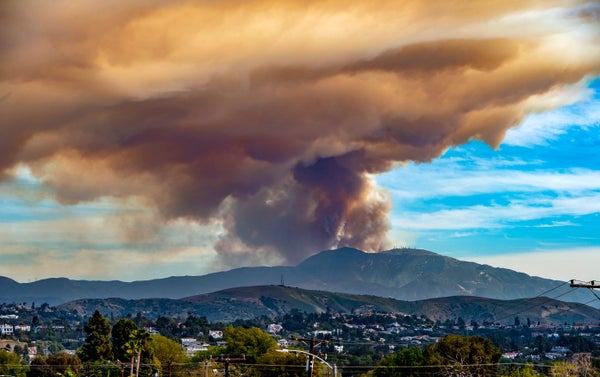
CLIMATEWIRE | Right now, 12 wildfires are burning through nearly 280,000 acres in five states. Many more will burn in the months ahead, thanks to a changing climate that is resulting in widespread dryness across the U.S.
Already, the country has seen hundreds of thousands more acres burn than usual for this time of year. Between Jan. 1 and May 4, wildfires had burned over 1.1 million acres. Over the last 10 years on average, those four months see about 707,000 acres burned, according to the National Interagency Fire Center (NIFC). In drought-stricken California, fires have already scorched 6,500 acres, more than double the state’s five-year average for this period.
Federal and state agencies are hoping high technology — literally — can help put fires out more quickly and save lives.
On supporting science journalism
If you're enjoying this article, consider supporting our award-winning journalism by subscribing. By purchasing a subscription you are helping to ensure the future of impactful stories about the discoveries and ideas shaping our world today.
The U.S. Forest Service is preparing to use two new types of drones: one designed to spot new fires, and another that can set fires around existing wildfires to deprive them of fuel.
Firefighters are being introduced to both technologies now through crash courses, to prepare them for a long, hot summer.
Currently, Northern California, Texas and the Central Great Plains are in drought, along with parts of the Gulf Coast, South Florida and the eastern Carolinas, according to NIFC. This condition, which results in “above normal significant fire potential,” is likely to continue into July.
In a normal year, the beginning of May would be just the start of what firefighters used to call “fire season.” But that era has passed, according to Jon Heggie, a battalion chief for the California Department of Forestry and Fire Protection (Cal Fire), the largest state wildfire control agency in the U.S.
“There’s no more talk about fire season,” Heggie said. “Now it’s always the fire year.”
Cal Fire, he said, is also preparing to use more drones, which are being adapted from autonomous aircraft previously developed and used by the military.
People who live near fire-prone, but remote, areas may also soon benefit from emerging technology for wildfire detection. Dryad Networks, a German company, is designing a system of cheap, low-power sensors that can be hung on trees to pinpoint traces of carbon monoxide and other gases emitted at the start of forest fires. The sensors would then send warning signals to satellites, which issue alerts.
And by next year, some firefighters will have computer-based “hazard mapping systems” that can give them “trusted information in real-time,” explained Andy Henson, vice president of artificial intelligence at Science Applications International Corp. (SAIC).
Firefighters have traditionally been limited by what they can see and what they’re told by radio contact from headquarters. SAIC, which is based in Reston, Va., is designing computerized “operation centers” that can be trucked or airlifted to collect information around major fires.
“You can have all the drones you want, but if you can’t get information back to firefighters, it’s useless,” Henson said.
Nighttime fires on the rise
The changing climate is not only driving more total fires, but also more fires that start or grow at night. That can make it harder for firefighters to detect them in time.
A recent study by the Cooperative Institute for Research in Environmental Sciences at the University of Colorado Boulder examined tens of thousands of wildfires around the world. It found that nighttime fires have increased by 7.2 percent since 2003. In the U.S., the rise has been 28 percent.
The reason, according to the study, is that rising temperatures have gradually reduced the moisture levels that night air could previously hold.
“It’s easier to start something on fire when they are dry and hot than if they’re cold and wet,” explained Adam Mahood, a fire ecologist and one of the authors of the study.
Researchers first heard anecdotal evidence from Brazil that fires were burning more often at night, Mahood said. After two years of studying data from recently launched satellites, the scientists were able to quantify the change. They call the cause “vapor pressure deficit.”
The study, recently published in the journal Nature, concludes that “traditional fire monitoring systems rely on ground-based cameras or satellite imaging to see smoke or flames and alert local firefighters, but by the time they detect them it’s often too late.”
The study notes that some of the most devastating forest fires have recently burned fiercely at night. They include California’s Dixie Fire in July 2021, which incinerated more than 963,000 acres, and the Marshall Fire in the suburbs of Boulder, Colo., which destroyed over 1,000 homes starting on Dec. 30, 2021.
Reprinted from E&E News with permission from POLITICO, LLC. Copyright 2022. E&E News provides essential news for energy and environment professionals.