
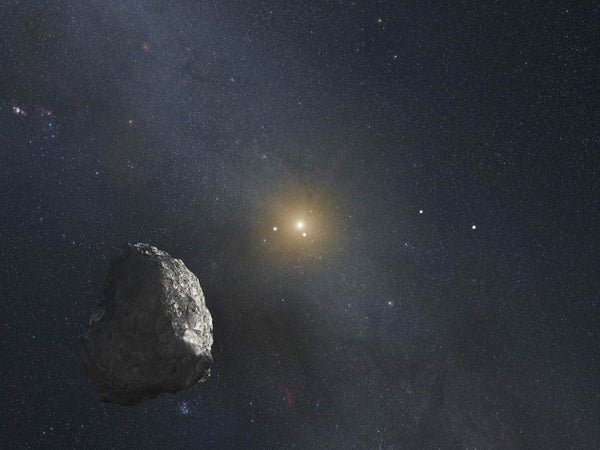

A new face has been added to the solar system's family portrait: Scientists have discovered a new dwarf planet looping around the sun in the region beyond Pluto.
The dwarf planet, called 2014 UZ224, measures about 330 miles (530 kilometers) across and is located about 8.5 billion miles (13.7 billion km) from the sun, NPR reported today (Oct. 11). For comparison, Pluto's largest moon, Charon, is about 750 miles (1,200 km) in diameter, and reaches a maximum distance of about 4.5 billion miles (7.3 billion km) from the sun.
A year on 2014 UZ224 (the time it takes the dwarf planet to orbit the sun) is about 1,100 Earth years. One Pluto year, for c is about 248 Earth years. The new object was also confirmed by the Minor Planet Center. [Meet the Solar System's Dwarf Planets]
On supporting science journalism
If you're enjoying this article, consider supporting our award-winning journalism by subscribing. By purchasing a subscription you are helping to ensure the future of impactful stories about the discoveries and ideas shaping our world today.
David Gerdes, a professor of astronomy at the University of Michigan, told NPR that the new dwarf planet was discovered using an instrument called theDark Energy Camera (DECam). The universe is not only expanding but accelerating in that expansion, and "dark energy" is the name scientists have given the mechanism powering that expansion. The DECam was built to observe the movement of galaxies and supernovas (exploding stars) as they move away from the Earth. The goal is to provide more clues that will help reveal what dark energy actually is or where it comes from.
A project called the Dark Energy Survey is using observations from the DECam to create a map of the universe that provides information relevant to the study of dark energy. The DES maps have already been used to study dark matter (which makes up about eighty percent of all the mass in the universe but whose exact nature is still a mystery) and to find previously unidentified objects.
Part of the DES includes taking images of a few small patches of the sky "roughly" once per week, according to the mission website, and that's what made this new discovery possible. While stars and galaxies appear in the same place in the sky, an object that is relatively close to Earth and orbiting the sun might appear to move over the course of a week or a few weeks.
A few years ago, Gerdes asked some visiting undergraduates to look for unidentified solar system objects in the galaxy map, according to NPR. The challenge was slightly difficult because the repeated observations would take place at irregular intervals, Gerdes said, but the students developed computer software to work with the irregularities and spot moving objects.
It took two years to confirm the detection of 2014 UZ224, NPR reports, and while its exact orbital path is still unclear, the scientists behind the discovery say they think that 2014 UZ224 is the third most-distant object in the solar system.
The smallest object in the solar system that has earned the title of "dwarf planet" (prior to this new discovery) is Ceres, which lies in the asteroid belt between Jupiter and Mars. Ceres is 590 miles (950 km) across. The object 2014 UZ224 might be too small to be considered a dwarf planet, Gerdes told NPR, but that will have to be decided by the International Astronomical Union (which made the controversial decision to demote Pluto to a dwarf planet). There are four other recognized dwarf planets in the solar system, but scientists think there could be dozens—or even more than 100—objects that size that have yet to be discovered, according to NASA.
Planet nine?
The region beyond Neptune's orbit is known as the Kuiper Belt, a disk that is believed to contain thousands of icy, rocky bodies. Beyond that is a region known as the Oort Cloud—a sphere of icy, rocky bodies that surrounds the rest of the solar system. Most comets originate in the Kuiper Belt or the Oort Cloud, but their wide orbits bring them close to the sun.
While the outer regions of the solar system are thought to be made up mostly of objects smaller than Pluto, there may be another planet nearly the size of Neptune lurking in this outer territory. Recent research has shown that the movement of known bodies in the outer solar system may point to the existence of this ninth planet (which scientists have dubbed Planet Nine); that research has prompted efforts to spot the new planet with telescopes.
Copyright 2016 SPACE.com, a Purch company. All rights reserved. This material may not be published, broadcast, rewritten or redistributed.