
Mammals run hot. The ability to maintain an elevated, constant body temperature—known scientifically as endothermy and colloquially as warm-bloodedness—is a critical part of what has allowed these beasts to adapt to many different habitats, from polar seas to searing deserts. Exactly when mammals evolved this ability, however, has long been a mystery.
Finding direct evidence of how ancient organisms’ physiology worked is a challenging task. The soft tissues that would be the most informative about warm- or cold-bloodedness are rarely preserved in fossils, and paleontologists obviously cannot directly measure an extinct animal’s body temperature. But by looking to the inner ears of fossil mammals and their relatives, paleontologists have discovered that mammals started to warm up just as the Age of Reptiles entered full swing.
The new study by paleontologist Romain David of the Natural History Museum in London and his colleagues focuses on the semicircular duct system, or SDS, in mammals’ inner ears. As the researchers report on Wednesday in Nature, these tiny loops inside the ears of vertebrates regulate critical functions such as balance, vision and motor control. The evolution of these structures was influenced by body temperature: a relatively high temperature causes the fluid inside the loops to become less viscous, so inner-ear ducts and canals are shaped differently and are often smaller in warm-blooded species than they are in cold-blooded ones. David and his colleagues used inner-ear shape and size as a proxy for an animal’s body temperature and behavior to determine when mammals started to become endotherms.
On supporting science journalism
If you're enjoying this article, consider supporting our award-winning journalism by subscribing. By purchasing a subscription you are helping to ensure the future of impactful stories about the discoveries and ideas shaping our world today.
“I was surprised that the inner ear could help us to assess body temperature and warm-bloodedness so well,” David says. The entire project began with a postconference discussion between him and his co-author Ricardo Araújo a paleontologist at the University of Lisbon, about why fish have much larger inner ears for their size than land-dwelling animals do. The researchers mused that body temperature could explain the difference—and that this difference might also show up in fossils. The researchers set about amassing a data set of 56 fossil synapsids, the group that contains mammals and their relatives, to pinpoint when mammal ancestors crossed this critical physiological threshold.
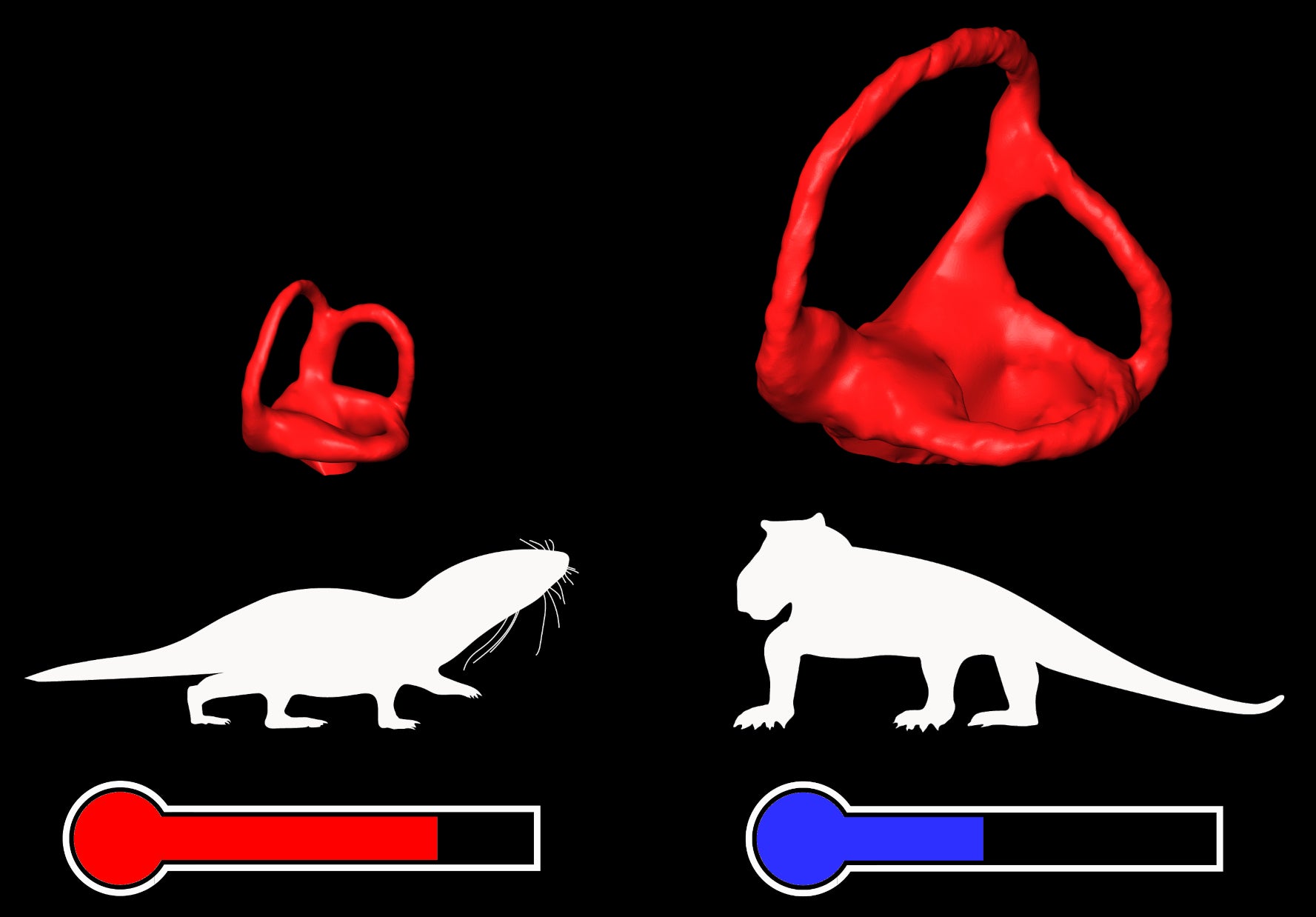
Size differences between inner ears (in red) of warm-blooded mammaliamorphs (on the left) and cold-blooded, earlier synapsids (on the right). Inner ears are compared for animals of similar body sizes. Credit: Romain David and Ricardo Araújo
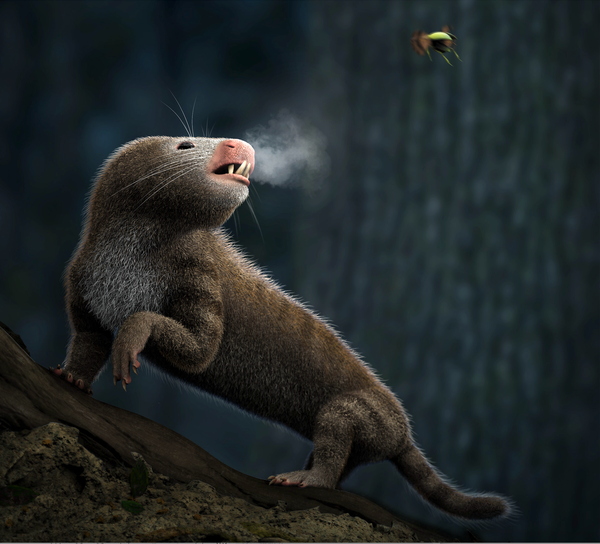
Mammal forerunners started warming up around 233 million years ago, during the Triassic period, the researchers propose. At that time, dinosaurs were just beginning to proliferate, reptiles were the most prominent and diverse creatures on land, and mammal predecessors were relatively small, somewhat weasel-like creatures. Technically known as mammaliamorphs, the latter underwent quite a jump in body temperature—between five and nine degrees Celsius—during this period. That timing means warm-bloodedness is a very ancient inheritance that evolved before the first true mammals.
“Researchers have been trying to unpick the trajectory of mammal characteristics like endothermy for decades,” says University of Oxford paleontologist Elsa Panciroli, who was not involved in the new study. Each past method came up with different answers on timing and which sorts of mammal relatives ran warm. But the new results based on inner-ear anatomy appear to be “robust,” Panciroli says—especially because the same relationship between SDS and body temperature can be observed in living species.
The results recalibrate what some previous studies had proposed about the origins of endothermy in mammals. Using other lines of evidence including bone chemistry and cellular structure, they had hinted that endothermy evolved even earlier among protomammals that lived more than 252 million years ago, such as saber-toothed carnivores called gorgonopsids and beaked, tusked herbivores called dicynodonts. Despite such prior research, however, the new evidence indicates that warm-bloodedness became a major feature of mammalian history millions of years later. The new study’s date of about 233 million years ago was closer to when small, furry creatures (more akin to what we think of as true mammals) began to evolve. Given that the origins of traits such as sensitive whiskers and changes to sound-conducting inner-ear bones occurred during the Triassic, study co-author and Field Museum paleontologist Kenneth Angielczyk notes, “it ends up not being that surprising that endothermy was emerging along with everything else.”
There are some caveats to the new study’s conclusions. As in previous research, some of the protomammals the researchers examined seem like they were closer to warm-blooded, and some early mammals appear to have been more cold-blooded. “Researchers have recognized for a long time that the features that distinguish mammals—such as warm blood, fur, milk production and increased activity—probably all evolved scattershot across different groups at different times,” Panciroli says. The new study identifies the overall shift in mammaliamorph body temperature, but there were always some individual species that broke the rules.
Evolving warm body temperatures and becoming much more active contributed to mammals’ spread and success during the Age of Reptiles. In the past two decades, paleontologists have overturned the old notion that mammals during the Triassic, Jurassic and Cretaceous were all tiny, insect-munching critters that ran around in the dark. Recent finds have also established that early mammals and their relatives swam, dug, glided from tree to tree and even ate baby dinosaurs. Bodies that ran warm and fueled much more active and complex behaviors underwrote the success of the mammals even as dinosaurs towered over them—a critical part of the deep backstory of ourselves and the magnificent beasts we see around us today.