
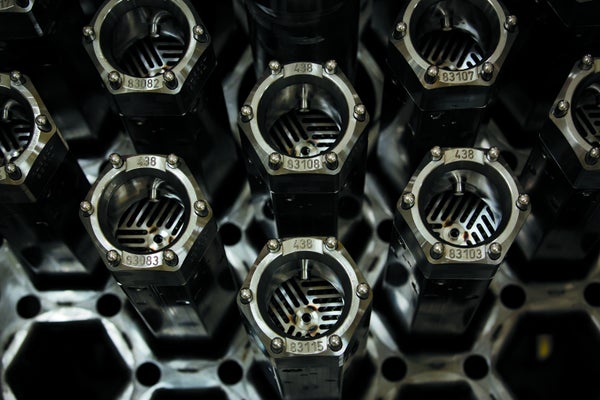
Engineers are redesigning the uranium fuel used in almost all nuclear reactors worldwide to reduce both the chance of a hydrogen explosion and the release of radiation during an accident—which is what happened in 2011 at Japan’s Fukushima Daiichi power plant. The new fuels, which must still be perfected, are already being tested.
In a reactor core, uranium atoms are split, releasing neutrons and heat. Systems in and around the reactor keep the core from getting too hot. Improving the fuel so it is less likely to melt or crack under high heat, and less likely to lead to hydrogen production, can reduce the risk of radioactive material being released during an accident. The same enhancements could allow power plant operations to run more efficiently and generate electricity more competitively.
All 98 power reactors running in the U.S., regardless of their design, use uranium fuel pressed into cylindrical ceramic pellets, each the size of a large pencil eraser. The pellets are stacked inside long fuel rods made of a zirconium alloy, and the rods are submerged in water. During fission, neutrons released from the fuel pellets pass easily through the zirconium and enter other fuel rods, where they sustain a heat-producing chain reaction. The heat turns water to steam, which generates electricity.
On supporting science journalism
If you're enjoying this article, consider supporting our award-winning journalism by subscribing. By purchasing a subscription you are helping to ensure the future of impactful stories about the discoveries and ideas shaping our world today.

Credit: José Miguel Mayo
Zirconium has long been used to form fuel rods precisely because it is so permeable to neutrons. The thinking was that uranium exploration, mining, processing and enrichment (increasing the proportion of nuclei capable of producing a chain reaction) would be complex and expensive. The science of arranging a reactor core to optimize energy output was young as well. Neutrons seemed too precious to be lost. But as the Fukushima accident demonstrated, on live television, if zirconium overheats, it can react with water (or steam) to produce potentially explosive hydrogen.
Today reactor design and operation are more sophisticated, and uranium has proved plentiful and readily enriched, so plant operators can afford to sacrifice a few neutrons. As a result, scientists and engineers are now perfecting alternative designs that can minimize hydrogen production and withstand more heat.
Spurred on by the Fukushima accident, manufacturers, working with the U.S. Department of Energy, are moving briskly on four so-called accident-tolerant fuels, each with a markedly different approach. Because all of them could be swapped into existing reactors with little or no need to modify reactor hardware, they could be phased into current machines during the 2020s.
Three competing companies that already produce the bulk of the industry’s fuel—Framatome, GE Hitachi Nuclear Energy and Westinghouse Electric Company—have begun to test small quantities in existing reactors. The idea behind these designs is to reduce the likelihood of problematic zirconium reactions by coating the zirconium, replacing it or changing the fuel-pellet ingredients altogether.
A fourth concept, from Lightbridge, a new U.S. market entrant, combines uranium and zirconium into a single, less reactive alloy shaped like a licorice stick, a configuration that would transfer heat better. The uranium would have to be enriched to higher levels than are allowed today, so U.S. regulations would have to change.
For decades utility owners have had difficulty gaining regulatory approval for any type of new fuel, but they are trying again, sensing a need to compete with inexpensive natural gas and increasingly abundant solar and wind power. U.S. owners are getting design and manufacturing help from an extensive nuclear research and development infrastructure, notably the National Laboratories. Yet the effort is quickly becoming global. In July 2018 scientists from the U.S. and the European Union held a workshop at Idaho National Laboratory to discuss how to best pool research on both continents. The Organisation for Economic Co-operation and Development is developing a framework for testing new fuels. If accident-tolerant fuels perform well, nuclear power could regain momentum in Japan, where debate continues about how much of the nation’s reactor fleet to restart.
Of course, significant hurdles must be cleared. Considerable in-core testing of small fuel quantities and computer modeling of performance, under both normal operating and accident conditions, have to be done before new fuels are ready for commercial use. Industry skeptics will have to be convinced that the new materials will work as promised. More advanced modeling techniques are coming online to aid this effort. Simulation technology at the U.S. Department of Energy’s Consortium for Advanced Simulation of Light Water Reactors, based at Oak Ridge National Laboratory in Tennessee, could significantly speed up basic research, engineering development and commercialization.
If data from trials are convincing, the U.S. fuel-supply chain—from the fabrication shop to the reactor-refueling floor—would have to retool, and plant processes and procedures would have to be adjusted. Regulators would have to approve every step.
Rethinking fuel may be just the beginning of greater change. Scientists and engineers are designing high-temperature gas-cooled reactors that would use uranium particles wrapped in exotic coatings; gumball-like pellets themselves would control the nuclear reaction rather than control rods commonly inserted among fuel rods. Also underway are molten salt reactors, in which the fuel and reactor coolant can be combined, allowing simple mechanisms to prevent overheating.
The natural gas, solar and wind industries have changed considerably in just a few years. The nuclear energy industry may be ready to reinvent itself as well.
*Editor’s Note (7/4/19): This sentence was edited after posting to clarify that the fuel rods are contained within the hexagonal structures.