
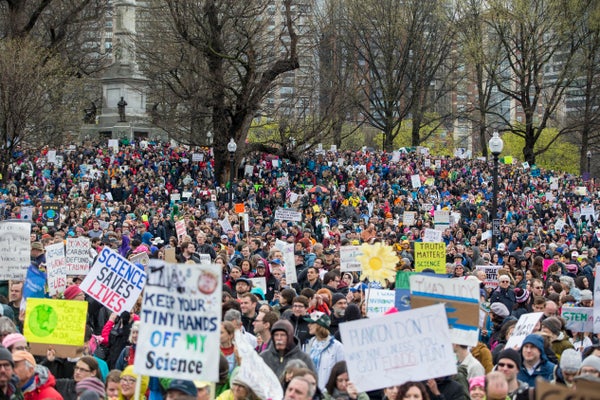
Science has gotten more political, so scientists are looking for new ways to influence politics.
Last week, a group called the National Science Policy Network announced its debut. It’s aimed at formalizing loosely linked groups of early-career scientists who want to get involved in policymaking.
Symbolically, it’s pushing back against the Trump administration’s efforts to cut research funding. Practically, it’s providing grant money to academic researchers in a wide variety of scientific fields, including biomedical, life, engineering, physical, law and public policy.
On supporting science journalism
If you're enjoying this article, consider supporting our award-winning journalism by subscribing. By purchasing a subscription you are helping to ensure the future of impactful stories about the discoveries and ideas shaping our world today.
They are boosted by funds from Schmidt Futures, a philanthropic group formed by Eric Schmidt, a Google executive involved in scientific philanthropy.
The network is also connecting young scientists with Obama administration alumni who worked under John Holdren in the White House Office of Science and Technology Policy. Trump hasn’t nominated a science adviser to fill Holdren’s job.
The new network isn’t political, per se, but its participants say they are motivated by the Trump administration’s retreat from science.
“Most of these groups have popped up in the last year or two are concerned that their work is in jeopardy,” said Michaela Rikard, a biomedical engineering Ph.D. student at the University of Virginia.
Young scientists are wondering, “How is this affecting my future career options?” she said.
It turns out 45 percent of the science policy groups on university campuses have formed in the last year and a half—since Trump took office—according to an NSPN study of 22 campuses. The groups are made up mostly of undergraduate students, and each operates on about $1,000 per year.
The NSPN will dole out grants ranging from $1,000 to $3,000.
This fall, it will host a conference in New York City to bring students together from across the country.
The group also has an arm focused on the midterm elections. Research America gets involved in campaigns to emphasize the importance of science when creating public policy. It invites candidates from both parties to tour laboratories, among other things, explained Rikard.
Trump is not the only factor contributing to the growing presence of science policy groups, she added.
“I think we’d still be here [even if Trump wasn’t],” she said. “I don’t think we’d have the momentum that we have right now.”
One of the Obama alumni involved is Kumar Garg, now a senior fellow at the Society for Science & the Public. He said young academics are motivated by the idea that science needs defending. “The other part is them wanting to be involved in the public sphere throughout their career,” he said, “and being an engaged citizen.”
Reprinted from Climatewire with permission from E&E News. E&E provides daily coverage of essential energy and environmental news at www.eenews.net.