
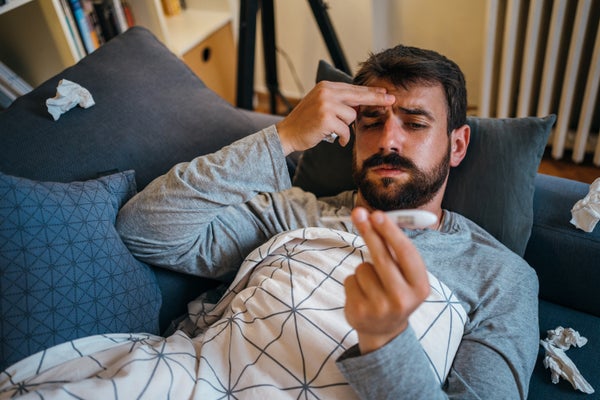
For three pandemic years, people with runny noses and fevers have sweated out a tough question: “Is this COVID, which has killed more than a million Americans, or is it a more familiar flu?” Many of the symptoms overlap. But now the first home test that distinguishes between COVID and the flu has been authorized by the U.S. Food and Drug Administration. With just one swab, the test can differentiate between three respiratory viruses—the COVID-causing pathogen SARS-CoV-2 and influenza A and B—with high accuracy in 30 minutes.
Unfortunately, the future of the product remains uncertain. The FDA’s emergency use authorization for the test was issued in late February, just two days after the test’s manufacturer, Lucira Health, announced that it had filed for Chapter 11 bankruptcy protection.
The flu-and-COVID test had already been authorized for home use in Canada and Europe, as well as for U.S. health care settings such as hospitals and doctor’s offices, prior to the FDA’s emergency use authorization. Now it has been authorized to be sold directly to consumers without a prescription in the U.S. Its technology is closer to elaborate lab-based polymerase chain reaction (PCR) tests than to the frequently used home antigen tests. Like PCR, Lucira’s product uses enzymes to replicate viruses’ genetic material and amplify it to a level at which it can be easily recognized. It is more sensitive than antigen testing.
On supporting science journalism
If you're enjoying this article, consider supporting our award-winning journalism by subscribing. By purchasing a subscription you are helping to ensure the future of impactful stories about the discoveries and ideas shaping our world today.
Not only is the product the first combined flu and COVID home test—it is the first home flu test accepted for use in the U.S. In the past, researchers had tried to develop antigen tests for flu, but the assays couldn’t achieve a high enough degree of accuracy, says Susan Butler-Wu, a clinical microbiologist at the University of Southern California’s Keck School of Medicine. “We’ve known for a long time that antigen performance for flu is really pretty crappy,” she says.
In people with symptoms, Lucira’s test correctly identified 88.3 percent of samples that were positive for SARS-CoV-2, as well as 90 percent of samples that were positive for influenza A, according to the FDA. (The test did even better at detecting samples that were negative for these viruses: it had at or close to 100 percent accuracy. This is important because false negatives give people false reassurance.)
The test also identified 99.9 percent of samples that were negative for influenza B, but these data are incomplete because that strain of the virus is not circulating in high enough quantities for researchers to conduct a clinical study. Lucira is required by the FDA to continue collecting data on influenza B.
Lucira’s test uses a technique called loop-mediated isothermal amplification (LAMP), which is a little different from PCR. It is “kind of like [PCR’s] cousin,” Butler-Wu says. PCR cycles a sample through several different temperatures in order to amplify genetic material. LAMP, by contrast, can take place at just one temperature, making the processing equipment simple enough to be used at home. Lucira’s test does need power, and the single-use plastic apparatus comes with two AA batteries.
The FDA’s emergency authorizations have allowed COVID vaccines, drugs and tests to enter the market since 2020. These authorizations are separate from the public health emergency that the Biden administration plans to end in May, so Lucira’s test won’t be deauthorized at that time.
It is still unclear how Lucira’s bankruptcy will affect the availability of its product. The company, anticipating authorization, had manufactured sometest kits that it will now be able to sell, a spokesperson told Scientific American. Lucira is seeking to sell its business under Chapter 11 in order to resume manufacturing its products, which also include COVID-only, LAMP-based home tests. The company is not yet disclosing when the new combination test will be launched or where it will be sold, though its at-home COVID-only tests are available on Amazon and through its website.
Lucira has also not yet announced the price of the at-home product, though health care providers can purchase it for $99. Canadian consumers have been able to buy it for 98 Canadian dollars, or about $72, according to Lucira’s online store. In contrast, BinaxNOW, Abbott Laboratories’ popular COVID antigen test, costs about $12 per test. For antigen tests, however, the FDA recommends using multiple assessments at two-day intervals, depending on a person’s symptoms and exposure to the virus, which drives up the total cost.
One advantage of a test that tells COVID and the flu apart is that it will make it easier for doctors to figure out proper treatment quickly. “For flu, I might get Tamiflu, and then for [COVID], I might get Paxlovid,” Butler-Wu says. “So that’s where having that information can be really helpful.”
Getting that news at home from a test can speed up a normally slow diagnostic and treatment time line, says David Peaper, a medical microbiologist at the Yale School of Medicine. “A lot of these medications are very time-sensitive, so that they need to be started within a certain number of days of the onset of illness,” he says. But outside of flu season, the combination test may be less valuable. It may be better to not test for flu at all when the virus isn’t circulating, Peaper warns, because taking unnecessary tests risks false-positive results that can mislead doctors and patients about care.
The explosion of home testing during the pandemic has changed how both patients and doctors approach diagnosis and treatment of infectious disease, Peaper says. Prior to the spread of COVID, the only comparable FDA-approved home tests were for HIV. Now tests are in development for strep throat and respiratory syncytial virus (RSV). “I think it’s really created a change in expectations,” Peaper says. “It’s a clear demonstration that patients can do these things at home.”