
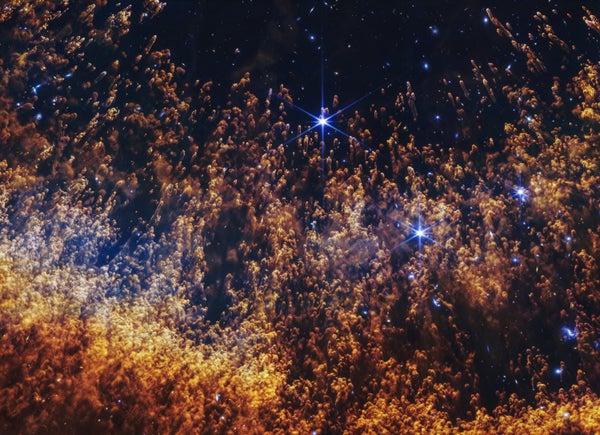
Even for astronomers who have gazed upon the same cosmic object over their whole career, new portraits of these celestial bodies from the James Webb Space Telescope (JWST) have the power to delight and amaze. See, for example, JWST’s latest images of the iconic Helix Nebula, also known as the “Eye of God,” a stellar grave site some 650 light-years from Earth in the constellation Aquarius.
“I thought this was a close-up of lavender until I saw the galaxies,” wrote Australian astrophysicist Jessie Christiansen in a social media post, referring to the nebula’s florid outline and JWST’s knack for catching far-distant galaxies in practically every observation it makes. (Click the link to her post above to see the galaxy-strewn close-up she referred to.)
The Helix Nebula is an example of what astronomers call planetary nebulas, a nod to their orblike shape, as seen in early telescopes. But the appearance of planetary nebulas has little to do with planets at all—these nebulas are actually roiling clouds of hot gas that emanate from dying sunlike stars and linger after their deaths. These echoes do still have a “planetary” connection because their wafting clouds of gas and dust serve as the raw material for new generations of stars and planets.
On supporting science journalism
If you're enjoying this article, consider supporting our award-winning journalism by subscribing. By purchasing a subscription you are helping to ensure the future of impactful stories about the discoveries and ideas shaping our world today.
A video compares images of the Helix Nebula from three NASA observatories: a visible-light image from the Hubble Space Telescope, an infrared view from the Spitzer Space Telescope and a high-resolution near-infrared look from JWST.
As revealed in the new JWST images, the Helix Nebula’s distinctive “Eye of God” structure is linked to a warm interior of recently ionized gas that is surrounded by cooler, older shells of dust that were ejected by a moribund star. Where the two meet, bundles of the hotter stuff pierce the dusty shell, creating knotty plumes that look vaguely like comets. Iconic photographs from pioneering observatories of decades past, such as the Hubble Space Telescope and the Spitzer Space Telescope, had shown this maelstrom as an extended haze around the nebula’s glowing iris.
Now the haze is gone. Thanks to the unprecedented resolution of JWST’s Near-Infrared Camera, the new images render this cloud of collisions as a richly textured tapestry of cosmic destruction and creation. Sparse tendrils of dust give way to billowing ripples of gas, forming myriad fractal structures in which, one day, new worlds may coalesce.