
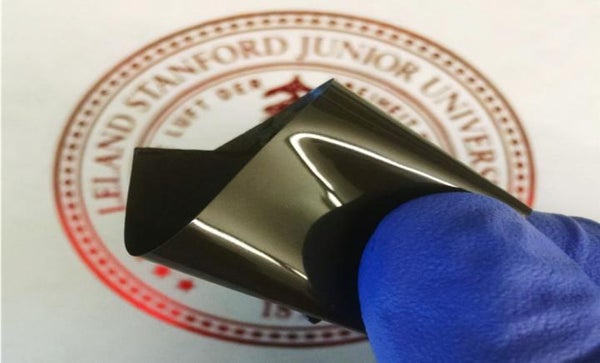
When coated onto a lithium-ion battery electrode, a new composite material protects the battery from bursting into flames if it is overcharged or develops an electrical short. The material, which may lead to safer designs of Li-ion and other types of batteries, was reported by Stanford University researchers in the inaugural issue of Nature Energy (2016, DOI:10.1038/nenergy.2015.9).
Li-ion batteries, which power devices including smartphones, electric cars, and hoverboards, rarely catch fire. Industry experts put the figure at less than 1 fire per 10 million battery cells, not counting battery abuse tests. Yet the batteries are used so widely and pack so much energy that researchers still strive to prevent these unlikely failures by coming up with ever more reliable safety features.
Some of the features in use or under development are based on thin films of protective materials within the battery that undergo changes in response to rising temperatures. The changes in the material’s structure or other properties block the flow of current, thereby allowing the battery to cool safely. Others strategies call for modifying electrolyte solutions inside the battery with chemical additives that inhibit combustion reactions.
On supporting science journalism
If you're enjoying this article, consider supporting our award-winning journalism by subscribing. By purchasing a subscription you are helping to ensure the future of impactful stories about the discoveries and ideas shaping our world today.
But these films and additives tend to cause irreversible changes—once they’ve been activated, the battery cannot be reused. Or the materials aren’t effective enough because they respond too slowly to temperature variations or work only in a narrow voltage range.

Stanford researchers are using spiky nanoparticles of graphene-coated nickel to create a lithium-ion battery that shuts down when it's too hot, then quickly restarts when it cools (1µ =1 micrometer).
Credit: Zheng Chen, Stanford University
So a team led by Stanford’s Yi Cui and Zhenan Bao developed a fast-acting thermoresponsive material and used it to coat Li-ion battery electrodes. The material is a composite that the team made from polyethylene and spiky nickel microparticles coated with graphene to enhance their electrochemical stability.
As fabricated, the material exhibits high electrical conductivity at room temperature. But within one second of reaching a critical transition temperature, the polymer swells, pushing the spiky particles apart. This change causes battery conductivity to plummet by seven to eight orders of magnitude, instantly switching off the device.
Compared with other materials studied as safety switches, the Stanford composite is more than 1,000 times as sensitive to temperature changes. In addition, unlike other switching materials, the new composite resumes normal function—as does the battery—when the battery cools.
In an accompanying commentary in Nature Energy, Khalil Amine, a battery safety specialist at Argonne National Laboratory, remarks that “this approach provides reliability, fast response time, and reversibility, without sacrificing battery performance, a combination that was difficult to achieve with previous methods.”
He notes, however, that the team evaluated the safety strategy only in small coin-type batteries. In larger, thicker batteries—such as those used in electric vehicles—heat propagation may not be fast enough to instantaneously trigger the switching material to shut down the battery. So further study is needed.
Nevertheless, Amine notes that the materials design of this work “provides a promising strategy to solve the long-standing safety problems of high-energy-density batteries.”
This article is reproduced with permission from Chemical & Engineering News (© American Chemical Society). The article was first published on January 12, 2016.
