
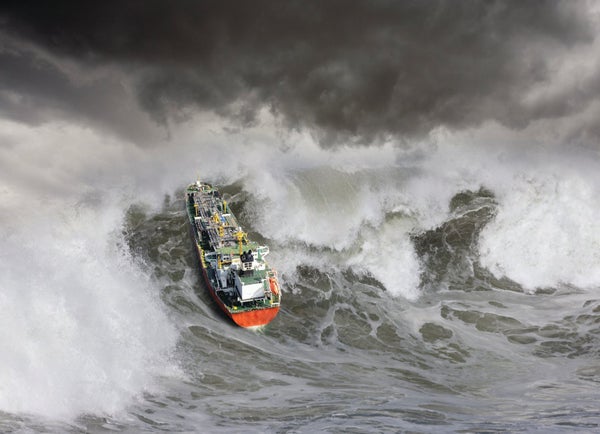
When giant waves —sometimes 30 meters tall, many times the height of the surrounding crests—suddenly rear up out of the ocean, they pose severe threats to even the largest craft. Unlike tsunamis, which may follow a large undersea earthquake, these so-called rogue waves have no known definitive origin. Nor can they be predicted. Understanding how they form is key to forecasting where and when they might arise.
A group of mathematicians—Eric Vanden-Eijnden of New York University, Giovanni Dematteis and Miguel Onorato, both at the University of Turin in Italy, and Tobias Grafke of the University of Warwick in England—has now demonstrated a new way to predict rogue waves in experiments using a massive water tank. Their approach draws from the mathematical theory of large deviations, which quantifies how rare events occur. They treated rogue waves as a statistical entity called an instanton, a waveform that also arises from calculations in particle physics, information theory and risk management.
The scientists honed their model, described last December in Physical Review X, by mimicking rough sea conditions within a 270-meter-long water tank in Norway. The tank's machinery generated waves with particular characteristics the researchers could choose; by crashing tailored waveforms into one another, they identified centimeter-scale precursors that resulted in waves up to five times the height of the surrounding ones.
On supporting science journalism
If you're enjoying this article, consider supporting our award-winning journalism by subscribing. By purchasing a subscription you are helping to ensure the future of impactful stories about the discoveries and ideas shaping our world today.
The theory of large deviations also suggested that any combination of waves that leads to a significant height change will create a large wave with one distinctive shape, regardless of initial conditions—mathematically, wave formation should take the most likely route that leads to a rare event. And the tank measurements proved that true. “All rogue waves are alike,” Vanden-Eijnden says, “but each ordinary wave is ordinary in its own way.”
The team's model “seems to reconcile the two main theories used so far to explain large and rogue wave formation,” says Alvise Benetazzo, a researcher at Italy's Institute of Marine Sciences, who was not involved in the study. One theory suggests they come from smaller waves simply combining and piling up, and the other proposes that variations in wave shapes amplify height differences exponentially. Neither model had fully aligned with earlier observations or experiments.
But the new calculations account for both effects, which contribute in different amounts based on water conditions, and they can be used to estimate the likelihood and height of a rogue wave arising from any set of ocean conditions. The team is optimistic that if adapted to real-world oceans with winds, currents and movement in any direction, the model could be integrated into a prediction system on ships, towers and platforms.
“Many experiments still must be performed, especially in the field,” Benetazzo says. “That's the real playground where we want to explain rogue wave formation.”