
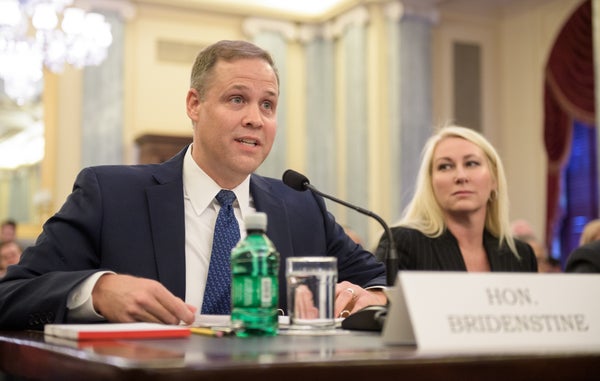
Jim Bridenstine shouldn’t necessarily expect smooth sailing now that he’s finally in as NASA administrator, experts say.
The U.S. Senate confirmed Bridenstine yesterday (April 19), more than seven months after President Donald Trump nominated the Oklahoma congressman for NASA’s top post. The final vote was 50-49 and strictly along party lines, with all Republicans supporting Bridenstine and all Democrats, along with both independents, opposing him. (Sen. John McCain, R-Ariz., is sidelined by health issues and did not vote.)
Such division is pretty much unheard of for NASA chiefs, who have generally been confirmed without much dissension or debate. And it will likely make Bridenstine’s job a bit tougher, at least in the early going, said space policy expert John Logsdon. [Presidential Visions for Space Exploration: From Ike to Trump]
On supporting science journalism
If you're enjoying this article, consider supporting our award-winning journalism by subscribing. By purchasing a subscription you are helping to ensure the future of impactful stories about the discoveries and ideas shaping our world today.
“The fact that it has gone on so long and been so contentious gives him more challenges than his predecessors had,” Logsdon, a professor emeritus of political science and international affairs at George Washington University’s Elliott School of International Affairs in Washington, D.C., told Space.com. “He’s got an uphill climb to establish that he’s a leader for all of NASA and all of the country.”
The senators opposed to Bridenstine’s nomination have cited, among other issues, his past statements questioning the reality of human-driven climate change (though the 42-year-old congressman has walked back such statements recently) and his lack of professional aerospace experience.
“The NASA administrator should be a consummate space professional,” Sen. Bill Nelson, D-Fla., said during a speech on the Senate floor Wednesday (April 18). “That’s what this senator wants—a space professional, not a politician, as the head of NASA.”
Indeed, Bridenstine is the first elected official ever to lead NASA. But he’s not the first administrator of the agency to lack a technical background, said Logsdon, who cited James Webb and Sean O’Keefe as precedents. (Webb led NASA from 1961 to 1968, and O’Keefe from 2001 to 2005.)
And despite NASA’s broad popularity across the ideological divide, the agency is not at some sort of magical remove from politics, Logsdon added. It is a government agency, after all.
“It hasn’t been deeply partisan, but it’s always been political,” Logsdon said. “Webb was political to his core.”
Bridenstine takes over from Robert Lightfoot, who has been acting administrator since President Trump took office in January 2017. That 15-month stretch is by far the longest ever served by an acting NASA chief. (Second place goes to Chris Scolese, who was acting administrator for nearly six months at the beginning of the Obama administration, in 2009.)
Last month, Lightfoot announced that he will retire from NASA on April 30—an impending deadline that Sen. Marco Rubio, R-Fla., cited yesterday to help explain why he switched his vote on Bridenstine’s confirmation from “no” to “yes.”
The confirmation could make it easier for NASA to get things done, because the new chief will have more clout with Congress, Logsdon said.
“An official [NASA] administrator can represent the administration, since they’ve chosen him, in ways an acting person — in particular, a civil servant—cannot,” Logsdon said. “Lightfoot did an admirable job, but he was a fill-in, and everyone knew it.”
Copyright 2018 LiveScience.com, a Purch company. All rights reserved. This material may not be published, broadcast, rewritten or redistributed.