
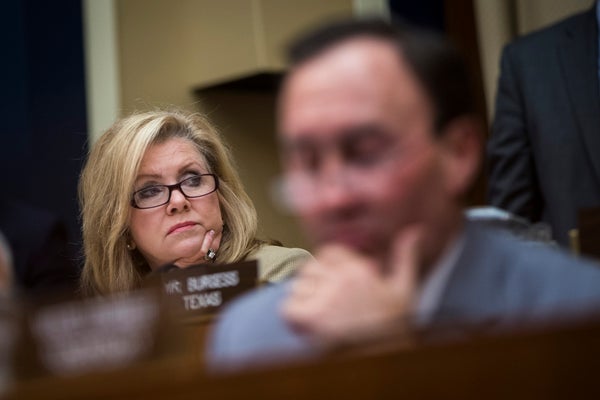
Hopes that Congress would take up the net neutrality cause took a hit Tuesday, when Rep. Marsha Blackburn (R-TN) introduced a bill that promises consumers some internet access protections. But the bill also includes several loopholes favoring internet service providers (ISPs). Blackburn’s Open Internet Preservation Act would prohibit ISPs from blocking or slowing internet traffic—an apparent attempt to blunt the U.S. Federal Communications Commission’s (FCC) revocation last week of the 2015 Open Internet Order. However, the bill would likewise limit the authority of the FCC and state governments to prevent ISPs from manipulating Web traffic in other ways.
One of the biggest concerns to emerge from the years-long debate over government regulation of the internet has been that loosely regulated ISPs would set up tiered internet service. This would potentially let deep-pocketed companies pay to have their content load faster than content produced by startups with more modest means. Blackburn’s bill, which seeks to amend Title 1 of the Communications Act of 1934, would not prevent that from happening. The proposed act would also make permanent the distinction that broadband internet access is a Title 1 information service—rather than a more tightly regulated Title 2 utility service, as the FCC had decided in 2015.
Blackburn’s bill is a “step in the right direction,” but is unclear and problematic in some important areas, says Jim Speta, a law professor and associate dean for international initiatives at Northwestern University’s Pritzker School of Law. Speta agrees that “Congress has too long been absent from the scene” when it comes to internet regulation, and that it is important for federal legislators to “engage in a serious debate over the scope of the internet and the FCC's authority over it.”
On supporting science journalism
If you're enjoying this article, consider supporting our award-winning journalism by subscribing. By purchasing a subscription you are helping to ensure the future of impactful stories about the discoveries and ideas shaping our world today.
It is also unclear how—or even if—the bill would regulate other major points of contention between ISPs and large content providers such as Google and Netflix: Should ISPs be allowed to offer faster service to content providers if they are willing to pay more? And should ISPs be permitted to give their own content and services priority over those offered by competitors?
The bill states that ISPs may not “impair or degrade lawful internet traffic,” with the caveat that they are allowed to perform “reasonable network management.” This does little to allay concerns that ISPs would be able to play a larger role in deciding winners and losers online. “From what I can tell, this is essentially the bill that the ISP monopolies have been calling for all along,” says Nathan Schneider, a media studies scholar in residence at the University of Colorado Boulder. “It prohibits blocking access to certain sites, which the big ISPs are fine with. But the reasonable network management provision appears to be capacious enough that it would allow fast lanes, variable service packages and pay-to-play conditions.”
Speta agrees that the bill seems to approve of paid prioritization, which was one of the major goals of the telecom companies supporting FCC Chairman's Ajit Pai's repeal last week of the 2015 rules. “The danger of paid prioritization is that the carrier will grant better service to certain services and, de facto, degrade the generic internet service,” Speta explains. “This bill seems not to allow the FCC to address such a development.”
“The carrier may offer its own services, it seems to me, even if that results in all internet services suffering,” Speta says. The 2015 Open Internet Order did not specifically regulate carrier-provided content either, but at the time the FCC acknowledged that it could be a problem if, for example, Comcast or Verizon provided faster and cheaper access to their offerings for their subscribers. The Obama administration FCC said it would watch out for the development of prioritized offerings, and “created a construct under which [the FCC] could act if it saw a problem,” Speta says. “This bill does forbid the offering of specialized services in any way that threatens the meaningful availability of broadband internet access services. But this seems an uncertain standard, and it is not clear to me that the bill envisions the FCC enforcing this principle.”
FCC Commissioner Michael O’Rielly, a Republican, issued a statement in favor of Blackburn’s bill, pointing out that O’Rielly has long advocated a legislative solution to the net neutrality issue. “This bill is a thoughtful approach, includes necessary boundaries and offers a realistic opportunity for compromise and finality on this much-debated issue,” he wrote.
The bill introduced by Blackburn—who also introduced legislation in 2015 to prevent the FCC from enforcing its Open Internet Order—is only the latest salvo in the long and often ugly debate over how ISPs are allowed to deliver their services. It is unlikely to be the last.